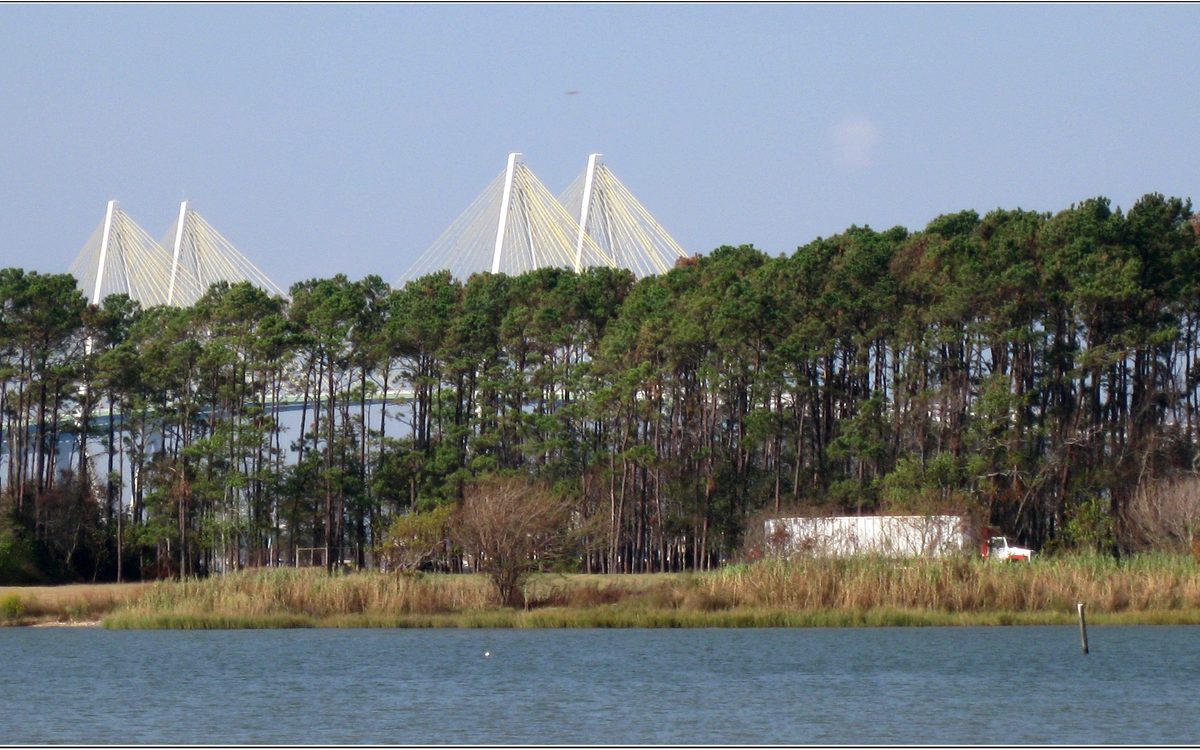
You know the morning I mean. You step out the door to get in the truck and something is wrong with the air, and it takes you a second to work out that what is wrong is that nothing is wrong. It is not wet. It does not lie on your skin like a towel. You can breathe it all the way down. The flag on the pole at the school has swung around and is pointing the other way, and the sky is a color it has not been since spring, a hard clean blue with no haze in it at all, and the stacks across the bay stand up sharp against it like they have been cut out with scissors. Somebody at the gas station says it, the thing everybody says: the front came through. And for one morning the whole town feels like it is on a holiday that nobody declared.
You should know what happened in the night, because it is one of the biggest machines on the planet, and it ran right over your house.
Start with the wind we have the rest of the year. From late spring to the end of summer the wind on the bay comes out of the south, off the Gulf, nearly every day. It is why every flag in town points north for months at a time. That wind is made by the sun and the shape of the coast. In the morning the sun heats the land faster than it heats the water; dirt and pavement warm in an hour, and the Gulf, which is deep and slow to change, barely notices. The warm air over the land rises. Cooler, heavier air over the water slides in underneath to take its place. That sliding is the sea breeze, and it starts at the beach and works inland through the afternoon, arriving at the bay with the smell of salt on it and sometimes a line of small storms that dump on one side of town and leave the other dry. At night the land cools faster than the water and the whole thing runs gently in reverse. It is a heat engine, in the plain physics sense of the word. Two things at different temperatures, air that moves because of the difference, and the difference paid for, every day, by the sun.
While we are on it: the summer air feels the way it does because of what sweat can and cannot do. Your body cools itself by sweating, and sweat only cools you if it can evaporate. Air already nearly full of water will not take much more, so the sweat stays on you and does no work, and you feel it as weight. The number for this is the dew point, the temperature at which the air would be completely full. All summer here it sits in the seventies. That is the towel.
A norther is the sea breeze's physics on a bigger scale.
Far to the north of us, over Canada and the high plains, the sun in the fall stands lower and the ground and the air above it cool. Cold air is dense; its molecules move slower and pack closer, and a cubic yard of it outweighs a cubic yard of the warm stuff. It piles up. And because the atmosphere does not sit still, every so often a big lobe of it breaks loose and slides south, heavy, hugging the ground, a wedge of cold air hundreds of miles wide and, near its leading edge, only a few thousand feet thick. That leading edge is the front. When it reaches the warm wet air we have been living in all summer, it does not mix with it. It gets underneath it and lifts it, the way a spatula lifts an egg. The warm air goes up, cools, wrings out its water, and that is the line of storms that comes through at two in the morning and rattles the windows. Then the wedge passes. The wind swings from south to north in the space of a few minutes. The pressure on the barometer starts to climb. The dew point can fall by twenty degrees in an hour. The sky clears from the northwest. And you wake up in a different air mass than the one you went to sleep in.
Old Texans called a hard one a blue norther. Nobody agrees on why; one story is the dark blue-black look of the cloud bank on the front, another is that it turns you blue with cold. On a strong one that bank is a steel wall you can see coming across the bay, and either story will do.
The front is not cold being pushed to us by anything. It is heat being moved. The whole atmosphere of the Earth is a machine for carrying warmth from the tropics, where the sun hits straight down, to the poles, where it hits at a slant. If that machine stopped, the equator would cook and the poles would freeze harder than they do, and the difference between them would grow until something gave. What gives, all the time, is the air. It flows from where it is warm to where it is cold, and because the planet is turning under it, the flow twists into the great loops and rivers of wind you see on the weather map, and the fronts are the seams where one body of air meets another. Every norther that comes down the plains is the planet evening itself out. The energy that drove it was sunlight falling on the Gulf and the tropics all summer long. The cold on your face that first morning is the leftover of a great deal of heat carried somewhere else.
The bay is the gauge for all of this. Watch it.
All summer the south wind piles water up against the north shore of the bay. It is not much, a foot or so on a stiff day, but the water stands higher against the pilings at Bayland Park on a south-wind afternoon than it has any right to, and the marsh grass along the shore spends more of its time wet. When Ike came in, the same kind of wind, multiplied past anything a summer afternoon can do, pushed the Gulf itself up into the bay and over the roads, and that is what the surge was: a sea breeze with a hurricane behind it. Then the first norther comes through, and the wind turns around and blows the bay back out toward the Gulf. The water level drops. On a strong front it drops a lot. The mudflats come up, gray and shining, out past where the water was, and the herons walk out on them to see what the bay left behind, and the pier stands on its legs like a wading bird with the water gone from around its knees. People who fish here call it a blowout tide. It is the bay showing you which way the wind is blowing, in a language you do not need instruments to read.
The plant reads it too, in its way. The flares lean south. The steam off the cooling towers, which all summer has drifted north, turns and goes the other way. On the first cool night the plant looks, from the pier, like it has turned to face the other direction.
I said the sea breeze was a heat engine, and I want to come back to that, because it is the turn of this essay and the reason the town has a stake in it.
An engine, any engine, is a thing that takes a difference in temperature and gets work out of it. A steam turbine has a hot side, the boiler, and a cold side, the condenser, and the steam flows from one to the other and turns a shaft on its way. A car engine has a hot side, the burning gas in the cylinder, and a cold side, the air outside, and the piston moves because of the difference. Take the difference away and no engine on Earth will run, no matter what you feed it. This was worked out by a young French engineer named Sadi Carnot, in one short book published in 1824, when he was twenty-eight, and almost nobody read it in his lifetime. He wanted to know why English steam engines beat French ones, and what he found was bigger than either: heat flows from hot to cold, and in the flowing you can make it do something, and the more the two sides differ, the more you can get. It is one of the few things in physics that is exactly as simple as it sounds.
Now look across the bay at the cooling towers. Every plant on the channel has them, and they are the least glamorous thing in it, big boxes that steam. They are the cold side. The furnaces are the hot side. Everything the plant makes, it makes by running heat from the one to the other and catching what it can on the way: the steam that turns the compressors, the cracking that takes a hydrocarbon apart, the distillation that sorts the barrel. The plant is a heat engine the size of a small city, and it runs on exactly the same rule as the wind that just came through your yard. Hot to cold. Work in between.
And the fuel is the same too, if you follow it back far enough. The furnace burns gas that was, a few hundred million years ago, a warm sea full of small living things soaking up their own summers. The norther is one summer's worth of sun, held in the Gulf since June and handed back in a night. One took longer to arrive. Both are the sun warming one thing more than another, and the difference doing work.
There is a night-shift operator somewhere on the channel who has felt the front come through from the top of a tower, where you feel it first. The wind turns, the temperature falls off, and the readings on the unit shift a little, because the cold dry air pulls more heat out of the pipes and the cooling towers, which work by evaporating water, work better in dry air than in wet, and the whole balance of the plant moves a hair. They adjust for it. They have been adjusting for it every fall for as long as there have been towers here. The plant and the weather are the same physics at two scales, meeting at a fence.
That is why the first cool morning feels like a holiday. Part of it is the relief. But the larger part is that for one day you can feel the machine running. All summer the engine was too slow and too even to notice; the same south wind, the same wet weight. Then the great cold wedge comes down the plains and the whole thing lurches, and the flags turn, and the bay draws back, and the air that has been pressing on the town for four months gets up and leaves, and you stand in the driveway with a cup of coffee going cold in the actual cold and understand, for a minute, that you live inside something enormous that is at work.
By afternoon the front is out over the Gulf and the sky over the bay is a blue with no bottom to it. The wind out of the north has dropped to a breeze. The mudflats are still out, and the herons are still on them, and the pier stands on its long legs over the wet gray ground. Out on the channel a tanker is coming up with the tide, and above it, for the first time since spring, the flag on the tallest stack points straight at the water.