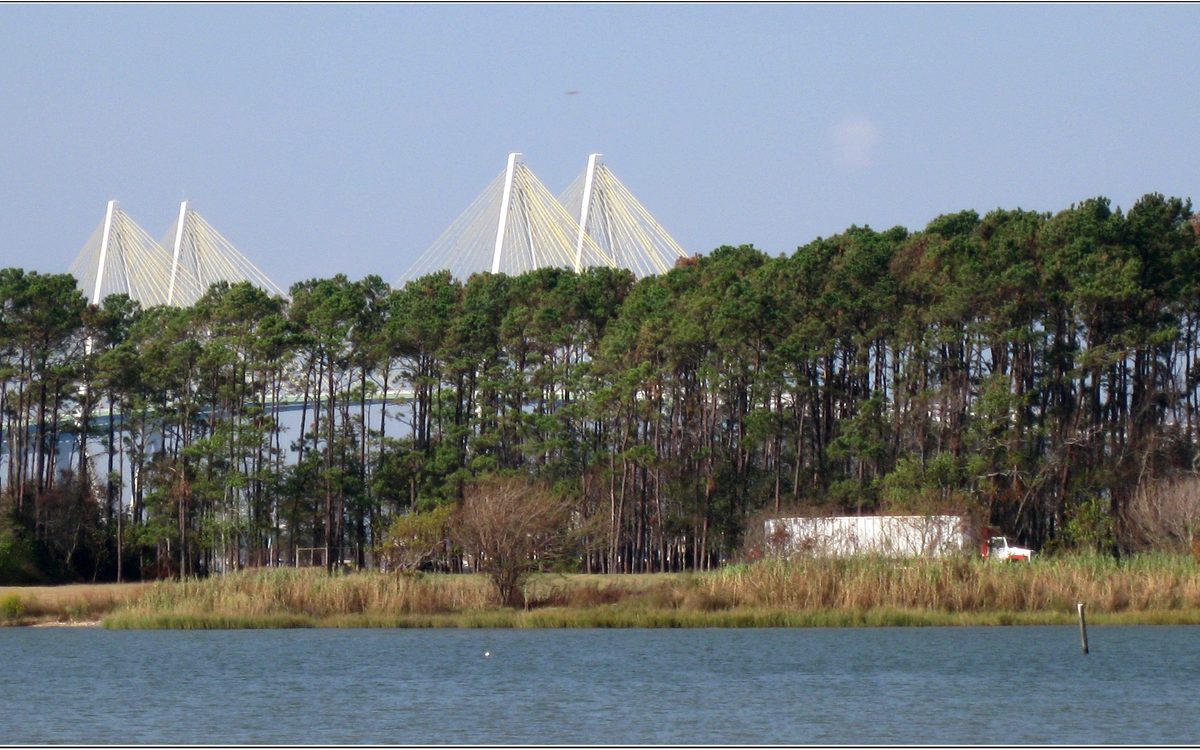
There is a week toward the end of September when the light over the bay changes and you notice the bridge again. All summer it has been there the way the heat is there, a fact you drive over without looking at, the towers gone soft in the haze by ten in the morning. Then the air dries out and one afternoon you come around the curve on 146 and it is standing up out of the marsh in front of you, pale, the two towers hard against a sky with actual depth in it, the cables catching the low sun so that for a second the whole thing looks strung with light. People who have lived here their whole lives slow down a little at that curve in the fall. I have seen them do it. I do it.
It is the tallest thing for miles, and it is tall for one reason: so that the ships can go under.
The design problem is that short, and I want to state it plainly, because the answer to it is the most Baytown object there is. The ship channel runs between this town and La Porte. The channel exists so that ships can get from the Gulf to Houston, and the ships have gotten bigger every decade since it opened in 1914, and the channel has been dug deeper, again and again, to take them. The road, 146, also has to get across. For about forty years it did so by going under, through a tunnel sunk into the channel bottom, and that worked until the day it did not, because a tunnel lying on the bottom of a channel is exactly where you cannot dig. So the bridge went up, and opened in 1995, and the tunnel came out, and the channel got deeper, and the ships got bigger, and the road kept going. The bridge is named for a Baytown newspaperman, which seems right. It is a sentence the town wrote across the water, and the sentence is: both.
I want to explain how it stands up, because the way it stands up is part of the argument.
Look at it from the pier at Bayland Park, which sits almost under its northern end, and you see two tall towers, one on each side of the channel, and from each tower a fan of cables running down to the road. That is a cable-stayed bridge, which is a different animal from the suspension bridges most people picture when they hear the word. A suspension bridge drapes one enormous cable over its towers, anchors the ends in the ground, and hangs the road from that cable on vertical wires, so the road is really hanging from two great ropes. A cable-stayed bridge does not hang the road from anything. Each cable runs straight, from a point on the tower to a point on the deck, and the deck is held up at dozens of points along its length, like a shelf held up by many brackets instead of one.
Now follow the forces, because this is where it gets good. Every cable is in tension. It is being pulled at both ends, by the tower and by the road, and it does the one thing a cable can do, which is resist being stretched. But a cable leaning at an angle does not just pull up. It pulls up and it pulls in, toward the tower. All those inward pulls, from all those cables on both sides of a tower, add up to a great squeeze along the deck, so the road itself is in compression, pressed toward the towers from both directions like a plank being pushed at both ends. And the upward pulls, meeting at the top of the tower, become a great downward push on the tower, which carries it to the ground. Tension in the cables, compression in the deck, compression in the towers. Nothing is loose. Every part is doing one thing, and the thing it is doing is the thing that material is best at. Steel wire is nearly impossible to pull apart and easy to bend, so you pull it. Concrete is nearly impossible to crush and easy to crack, so you push it. The whole structure is a diagram of forces that you can drive a truck across.
That is why the towers are the shape they are, and why they are so tall. The taller the tower, the steeper the cables can be, and the steeper the cable the more of its pull goes up instead of in, and the less the deck has to be squeezed. So you build the towers high, well over four hundred feet, and hang the deck a little under two hundred feet above the water, and a ship with its stack and its mast and its cranes passes underneath with room to spare, and the cars go over the top and most of them never think about the ship at all.
Stand on the pier when a big one goes under. It takes a long time. The bow comes into the shadow of the deck and the stern is still out in the sun, and the bridge does not move, does not tremble, does not know the ship is there. That is the point. The two things are not competing for the same place. One is above and one is below and each was designed on the assumption that the other exists.
Everything the town makes goes out one of two ways, and the bridge is where they cross. The barrel comes up the channel on a ship and goes into the plant; what the plant makes goes back out the channel on a ship, or out over the road on a truck. The kerosene that will lift a rocket goes under the bridge. The plastic that will be a car seat goes over it. The nurse who will be on the floor at the hospital on Garth Road at seven drives over it from the other side, and the operator who lives in La Porte drives over it the other way, and somewhere under both of them, at the same moment, a tanker is bringing in the next week's crude. The bridge does not decide which of these matters more. It carries all of them. It was built so that it would not have to choose.
And that is the town's argument, in steel. People who have not been here tend to think of a place like this as a place that had to choose. The plant or the bay. The channel or the marsh. The fuel or the air. The truth, which anybody who has lived here knows in their bones and few people say out loud, is that the town has never once had the luxury of choosing and has never once been willing to give either up, and so it has spent a hundred years building things that let it keep both. The nature center on the ground where a neighborhood sank. The pelicans fishing in the wake of the tankers. A bridge that goes up so that a channel can go down. None of it is tidy. All of it is the same answer.
I do not want to make the bridge into more than it is. It is a road. It is a road that had to be tall, and engineers who were good at their jobs made it tall in the most efficient way they knew, and it has stood through Ike and Harvey and every norther since without asking for credit. But if you want to know how a town that fuels the world thinks about the world, you could do worse than to look at what it built when it needed to get across the water. It did not fill the channel in. It did not stop the road. It built the tallest thing for miles and strung it with cables, and then it went back to work.
From the top of the bridge, on a clear fall afternoon, you can see the whole thing at once. The plants strung along the channel toward Houston, the stacks and the tanks and the flares, small and orderly from up here. The monument at San Jacinto, a white needle in the trees up the channel, where the republic got started in about eighteen minutes one April afternoon. The bay opening south toward Galveston and the Gulf, gray-green, with the ship channel drawn through it like a ruled line. The marsh below, and the birds. It is about the only place around here where you can hold all of it in one look. The bridge did not do that on purpose. It only wanted to be high enough for the ships. But there it is: the town, the water, the work, and the way out, all visible from a road that was built to be in nobody's way.
At night the lights along the deck draw the span across the channel in a long low curve, and the towers stand up dark above them with a red light at each top for the aircraft. From the pier you can just make out the cables against the glow of the plants beyond. A tanker comes up with the tide, low and dark and slow, the lights on its bridge the only sign of it, and slides between the towers and under the strings without touching anything. Above it the headlights go on crossing, and neither of them stops for the other.