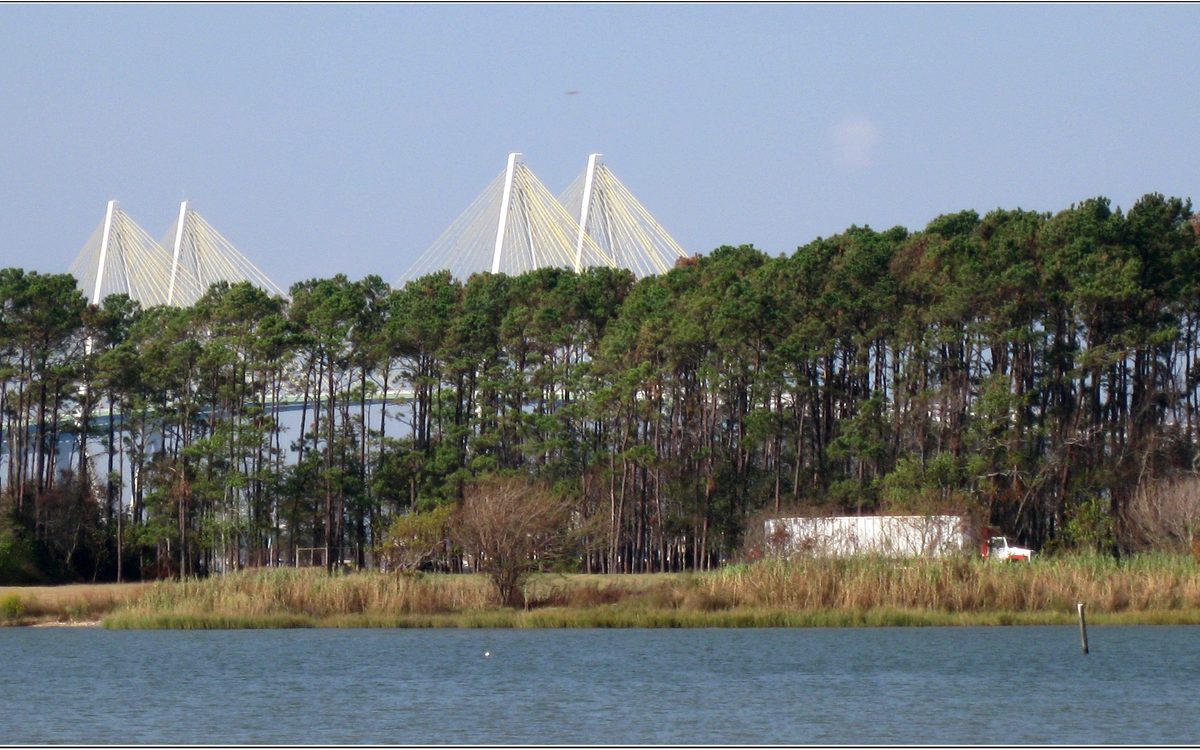
There is a stretch of late March on the bay when the wind swings around to the south and stays there, and the water at Bayland Park goes from gray to something closer to green, and you can stand at the end of the pier in a shirt with no jacket and not want either one. It lasts about ten days. Everyone in town knows the stretch, even if nobody names it. It is the week people fish off the pier after work again, the week the RV parks are full of turnaround crews eating dinner outside, the week you notice the pelicans.
They have been here all winter, of course. But something about the light in late March makes you look up, and there they are, a line of eight or nine brown pelicans coming down the bay a foot above the water, wingtips almost touching the surface, not one of them flapping. They ride the cushion of air between their wings and the water and they don't spend anything to do it. The trick is the water itself. A wing that close to a flat surface pushes air down and the surface pushes it back, and the air stacked up between wing and water carries the bird along the way a hand held out a truck window is carried. Pilots call it ground effect. The pelican has no name for it and was using it before there were runways. Behind them, a tanker is coming up the channel toward the docks, moving so slowly it looks parked, and the line of birds passes across its hull the way a hand passes across a page.
That is the picture. A bird that was very nearly gone from this coast, fishing in the shadow of the thing people assumed would finish it off.
The brown pelican is a big animal. Its wings open past six feet. It has a bill as long as your forearm and a pouch under it that stretches like a wet paper bag, and when it fishes it does something no other pelican does: it climbs, folds, and falls. It hits the water head first from twenty or thirty feet up, sometimes higher, at an angle it picked on the way down, and it hits hard enough that a person doing the same thing would be hurt. The bird isn't. Under its skin, along its chest and neck, there are air sacs that take the blow the way a padded jacket would, and a half-turn to the left as it goes under keeps the impact off its throat. The pouch fills with water and fish. The bird comes up, tips its head, lets the water out the sides of its bill, and swallows what's left. Laughing gulls sit on its head while it does this, hoping. It ignores them.
You can watch this a hundred times from the pier and it does not get old.
Now the part that people my age were told as children and that people younger than me may never have heard. In the middle of the last century, the brown pelican almost disappeared from the Gulf coast. Not from hunting, though there had been some of that earlier, from fishermen and plume hunters. From a chemical. DDT was sprayed on crops and marshes across the country for decades after the war, and it did what it was meant to do, which was kill insects, and it also did something nobody had planned on. It dissolves in fat and not in water, which means that once it is inside an animal it stays there, stored, and is not passed out the way most things are. It washed into the water, and small fish took it up, and bigger fish ate the small fish, and pelicans ate the bigger fish, and at every step the chemical concentrated instead of thinning out, because each animal kept its whole life's dose and handed it on. By the time it reached the top of that chain it was in the birds' fat and blood at levels that changed how their bodies handled calcium. The breakdown product of DDT, which is called DDE, interferes with the gland that lays down the shell around an egg. The pelicans laid eggs with shells too thin to sit on. The parents crushed their own eggs by warming them. A colony of a thousand birds would nest and produce almost nothing.
By the late 1960s there were stretches of the Texas coast where you could not find a breeding pair. In Louisiana, which has the brown pelican on its state flag, the bird was gone entirely. The bird was put on the federal endangered species list. The country banned DDT for most uses in 1972, and for a long time it looked as if it might have been too late.
It was not too late. You can put a number on that. Once the chemical stopped going into the water, the fish carried less of it, the birds carried less of it, and the eggshells thickened, and the chicks hatched. Birds were moved from colonies that still had them to coasts that didn't; Louisiana got its pelicans back from Florida, a few hundred young birds at a time, over years. Slowly, then not so slowly, the pelicans came back. Decades after the ban, the federal government took them off the endangered list because there was no honest way to keep them on it. They nest now on spoil islands and rookeries up and down this coast, and if you drive to Galveston you'll pass them sitting on every other piling, and if you stand on the pier at Bayland Park in late March you will see them working the same water the ships work.
A town like this one is always being asked to choose between two pictures of itself, and the pelicans refuse both.
The first picture is the one from far away. The refinery towers, the storage tanks, the flare at night, the ship channel full of hulls, and over all of it a dead brown sky. In that picture nothing lives here. You see it in stock photos and in the openings of documentaries about somewhere else. It is the picture people have in their heads when they ask you, in another city, what it's like to live in Baytown, and they lower their voice a little when they ask.
The second picture is the one on a brochure. Blue water, a pelican in flight, a sunset behind the bridge, and no towers at all, or one tower, far off, made small and soft by the angle. That picture is also a lie, just a friendlier one. It says the plants and the bay are two different places and you can have the one without looking at the other.
The bird in the actual air over the actual channel says something plainer than either. It says: the water is clean enough that I can raise young on what I catch in it. It says this about the same water that the tankers turn in. It says it with its body, by being here, because it cannot say it any other way and would not bother if it could. A pelican is not a symbol of coexistence. It is a fact of it, a large feathered fact with a fish in its mouth, and it does not care in the least what anyone means by it.
I think it matters that the thing that nearly killed the bird was not the thing this town makes. DDT was an insecticide, not a fuel or a plastic. But I also think it would be too easy to leave it there, as if the lesson were that somebody else made the mistake. The mistake was more general than a single molecule. It was the belief that what you put in the water goes away. It doesn't. It goes into a small fish and then a large one and then a bird and then an eggshell, and it comes back to you in the form of a silent island where a colony used to be. The same year the country banned DDT, it passed the law that says nobody may put anything into a river or a bay without a permit that lists what, and how much, and how often it will be measured. Every outfall on this channel has one of those permits, with numbers on it, and somebody whose job is to take the sample. The rules are not decorations. The pelican is one of the reasons they exist and one of the ways you can tell whether they are working. Nobody has to interpret a pelican. You count them. And people do, with clipboards and binoculars, every winter along this coast, and the numbers go into a ledger longer than any of our lives.
There is an operator I've talked to who works nights on one of the units near the water, and he told me that the pelicans come in at first light along the same line every morning, low over the cooling water outfall where the fish gather because the water is a few degrees warmer, and that on a cold morning you can see steam coming off the water and the birds dropping through it. He said he never gets tired of it. He said it the way people here say things, with no adjectives. Then he said the thing that has stayed with me. He said the birds were there before his unit and they'll be there after, and his job in the middle is to make sure that's true.
That is not a bad description of a job.
The long view of it is this. The crude in that tanker's hold began as the same kind of thing the pelican is diving for. A warm sea, a few hundred million years ago, full of small life, plankton and the things that ate plankton, dying and sinking and settling into mud, and the mud buried under more mud until it was rock and the rock was deep and hot enough to cook what was in it into oil. The plants on this channel take that apart and build it into fuel and fiber and film and pipe and the screen you are reading on. The bay, this morning, is growing the same small life in the same kind of water, and the mullet and menhaden are eating it, and the bird is folding its wings over the mullet. It is one bay and one long chain of eating, and the tanker and the pelican are both at the end of it, one of them carrying an old sea up the channel and the other carrying this morning's home to a nest. The difference between them is only time: a few hours from the plankton to the fish in the pouch, a few hundred million years from the plankton to the crude in the hold.
We are the part of the chain that knows it is a chain. That is our one distinction. The pelican doesn't know it nearly vanished and doesn't know it came back. We know. We know what thinned the shells and we know what thickened them, and we are the only animal on the bay that can decide what goes into the water tomorrow.
The ten warm days of late March will end. The south wind will bring the humidity up behind it and by the middle of April the pier will be sticky by nine in the morning. But for now, this evening, the tanker is turning in the channel with two tugs pushing on her, the sky not yet dark, and the birds are coming down the bay in their line, a foot above the water, not one of them flapping. The last of them clears her bow. The first of them climbs, folds, and falls.