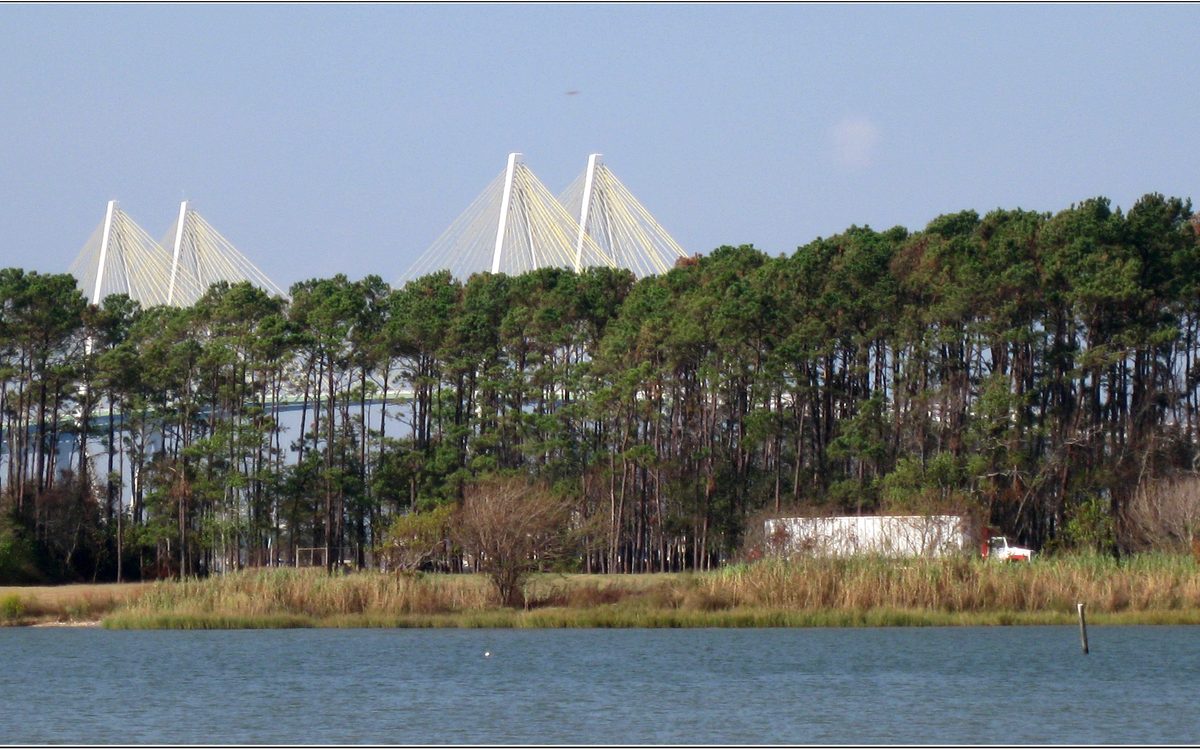
Baytown Birding Week runs November 18 to 22, 2026, and the Baytown Nature Center, 6213 Bayway Drive, is one of its stops. The center is open daily, from 30 minutes before sunrise to 30 minutes after sunset, and costs $4 for adults, $1 for children 5 to 12 and for seniors 65 and over. It sits on the streets of Brownwood, a drowned subdivision the bay took back. The birds you see there in November crossed a lot of country on fuel they made themselves.
Birding Week, in November, is when the peninsula fills up. Not with people, though the Nature Center gets more of those too, standing in the parking lot with binoculars around their necks and a thermos between their feet. It fills up with birds. They come in over the bay in the dark, most of them, and by the time the gate opens they are already there, working the ponds and the salt flats and the drowned lots where a subdivision used to be, as if they had booked ahead. Birding Week is the town's way of noticing. The 2026 week is a guided tour of the Baytown area, limited to 26 people; registration closes November 3 or when the vans fill, and tours and transportation are free for guests who book all four hotel nights through the official link. Two of its mornings are at the Nature Center. You do not need the tour to see the birds. It is a good week, or any week, to walk the trails slowly, pay the small admission, leave the dog in the truck, and watch the sky do something it has done for longer than there has been a Baytown to watch it from. On the third Thursday of every month from September through May there is also a free bird survey at 8 a.m.; bring your own binoculars.
You do not need to know the names. The names help, and the people in the parking lot will give them to you if you ask, but what you are looking at is not a list of species so much as an arrival. A bird that was somewhere far to the north a few weeks ago is now standing in a pond on the edge of the ship channel, and the only reason it is there is that it flew. Nobody carried it. Nothing carried it but its own body, and the body carried itself on a fuel it made from summer.
A bird crossing the Gulf is running an engine, and in the ways that matter it is the same engine as the turbines and furnaces on the other side of the fence.
The densest fuel

Start with the fuel. Before a long migration a bird eats, and it eats with a purpose that would look like illness in a person. It gains weight fast, and the weight it gains is fat. Some of the small ones will put on so much that they are close to double what they weighed in midsummer. They do this because fat is the densest fuel a body can carry. A gram of fat holds a little more than twice the energy of a gram of sugar or protein, and it holds it without water, which is what makes it light. A body stores sugar as glycogen, and every gram of glycogen drags about three grams of water along with it, so that the same energy, carried as sugar, weighs several times what it weighs as fat. A bird that stored its summer as sugar would be too heavy to lift off. A bird that stores it as fat is a tanker with wings.
Now look at what fat is. Chemically it is a long chain of carbon and hydrogen with a small oxygen-bearing head on one end. Strip the head off and what you have left is, near enough, a hydrocarbon. It is the same family of molecule as the kerosene in a jet engine and the gas in a furnace. Not the same molecule, but the same idea: carbon holding hydrogen, and energy stored in the holding. When the bird burns it, the chemistry is the chemistry of any fire. Carbon and hydrogen meet oxygen. Carbon dioxide and water come out, and heat, and the heat becomes work. The bird does it slowly, at body temperature, with enzymes instead of flame, but the ledger is the same. Fuel in, oxygen in, carbon dioxide and water out, motion in between.
A turbine on the channel does the same accounting faster. Gas goes in, air goes in, the mixture burns, the hot gas spins a shaft, and the shaft turns a compressor or a generator. What leaves the stack is mostly carbon dioxide and water vapor, which is why you can sometimes see a plume on a cold morning and not on a warm one; the water is condensing, the way your breath does. A bird over the Gulf is exhaling the same two things. It would be a strange comfort to a hummingbird, but it is true: the chemistry that moves it across five hundred miles of open water is the chemistry the town is built around.
Five hundred miles of water
Five hundred miles is about right. A ruby-throated hummingbird, which weighs less than a nickel, is generally understood to cross the Gulf of Mexico in one flight, from the coast down to the Yucatán, without landing, because there is nowhere to land. It cannot glide much. It has to beat its wings the whole way. It does this on fat it laid down in a few weeks of feeding, and when it arrives it is light and hungry and alive. Most of those crossings happen before Birding Week, in the weeks of September and October, so by November the hummingbirds are mostly across and gone, and what you find at the Nature Center is the later crowd: ducks, white pelicans, herons and the shorebirds that winter on the bay. The crossing still begins and ends on coasts like this one. The same water that the tankers cross with tugs and pilots and radar, the small birds cross on stored summer and instinct.
Not every bird takes the straight line. Some go around, hugging the Texas coast down into Mexico, trading distance for the chance to stop and refuel. Some go straight across at night when the air is cooler. The choice is written somewhere in the bird, and the birds that followed it badly are not here to be counted. What is standing in the pond in November is the result of a very long sorting.
The wing has its own physics. A wing works by pushing air down, and the air pushes back, and the pushing back is called lift. The faster a bird flies, the more lift it gets from the same wing, up to a point, and the more drag it pays for the speed. Every bird has a speed at which the trade is best, where it gets the most distance for each gram of fat, and the ones that migrate long distances fly close to that speed. It is the same calculation a ship's engineer makes on the channel. There is a speed at which a tanker burns the least fuel per mile, and it is not the top speed, and a good captain knows it. The bird does not know it. The bird just flies it.
The big birds, the geese and the ibises and the pelicans, do one more thing you can watch from the pier at Bayland Park on a clear evening. They fly in a line or a V, each one a little behind and to the side of the one in front. The bird ahead leaves a small rising swirl of air off its wingtip, and the bird behind rides it, and saves a little effort with each beat. Researchers who put instruments on ibises found the birds timing their wingbeats to catch that lift. Engineers know this as drafting, and the same principle is why trucks run close on the interstate and why cyclists ride in a bunch. The birds arrived at it first, by a few million years.
Without a single pipe

So the Nature Center, during Birding Week, is a place where you can see the whole idea of the town laid out without a single pipe. Energy is stored in a hydrocarbon. The hydrocarbon is carried a long way. It is burned with oxygen in a controlled way, and the burning becomes motion, and the motion gets something valuable from one place to another. In the plants that something is ethylene or gasoline or the plastic in the binoculars. In the sky it is a bird. The difference is scale and speed, and the difference is not small, but the principle does not care about scale.
There is one more likeness, and it is the one that stays with you. The peninsula the birds stand on is itself a story about energy and what it costs. Brownwood was a neighborhood. It sank because the ground under it was pumped, water in that case rather than oil, and the sinking let the bay in, and after Alicia in 1983 the town gave the land back. It did not choose to make a bird sanctuary. It made a mistake, and then it stopped making it, and the marsh came in on its own. The birds did not need an invitation. They needed the water to be there and the mud to be full of the small things they eat, and once it was, they came.
You can stand on one of the trails now, out where the streets still show under the grass if you know where to look, and see a white pelican settle onto a pond that used to be someone's backyard. Behind it, across the water, the towers of the complex are doing what they do, and at dusk the flare will come up orange against the same sky the birds came in through. The pelican is not making a statement about the flare. It is digesting. The flare, for its part, is burning off what has to be burned. Neither one is looking at the other, and both are spending a hydrocarbon.
Two summers

Where the bird got its hydrocarbon is worth tracing, because it did not eat fat. It ate insects and berries and seeds, and the berries were sugar, and the insects had eaten leaves, and somewhere back along that short chain a plant took carbon dioxide out of the air and built it into something the bird could swallow. The bird's liver then did what a refinery does in reverse of its usual order: it took small molecules and stitched them into long chains, and packed the chains under the skin and around the gut. A bird in September is a small chemical plant running a synthesis. A bird that finished its crossing in October has already burned most of what it made. The two summers, the bird's and the oil's, are not the same length by a factor I cannot picture, but the carbon in both was pulled out of the air by something green, and the ledger closes the same way when it burns.
Ask an operator on the night shift what he watches from the top of the unit and he may tell you it is the birds, the one thing up there that is not on a gauge. He can see the bay, and in the fall he can see the lines of them coming in low across it just before the sky goes fully dark, headed for the peninsula. He does not know their names either. He does not need to. They are going somewhere, on fuel they made themselves, with no chart and no radio and no one on the ground to talk them in, and they know the way, and that is enough to make a person at the top of a tower, with every number he needs on a screen in front of him, feel briefly like a beginner.
Walk the loop at the Nature Center during Birding Week and go slowly. Watch a heron stand in the water so still that the water forgets it. Watch a flight of ducks turn all at once, as if the turn were one decision made by forty bodies. Then look up, past the trees, at the stacks and the vapor and the steady work of the place. Something over there is being taken apart and burned so that something else can move. The heron in front of you did the same thing to a minnow an hour ago.
At the end of the last trail the ground drops off into the bay, and in the late light you can see the water go from brown to silver to a kind of bruised blue as the sun goes behind the refinery. The birds settle. The ducks stop turning. A pelican folds itself into the shape of a rock and, with no idea what it is standing on, goes to sleep on top of a street.
Read next: The Nature Center, season by season, Nurture Nature and Birding Week — the standing guide.
En español
Las aves conocen el camino
La Semana de Observación de Aves de Baytown (Birding Week) es del 18 al 22 de noviembre de 2026, y el Baytown Nature Center, en 6213 Bayway Drive, es una de sus paradas. El centro abre todos los días, desde 30 minutos antes del amanecer hasta 30 minutos después del atardecer, y cuesta $4 para adultos y $1 para niños de 5 a 12 años y para personas de 65 años o más. Está sobre las calles de Brownwood, un fraccionamiento hundido que la bahía recuperó. Las aves que usted verá ahí en noviembre cruzaron muchísimo terreno con un combustible que ellas mismas fabricaron.
La Semana de Observación de Aves, en noviembre, es cuando la península se llena. No de gente, aunque el Nature Center también recibe más, con binoculares colgados al cuello y un termo entre los pies en el estacionamiento. Se llena de aves. La mayoría llega sobre la bahía en la oscuridad, y cuando se abre la puerta ya están ahí, trabajando los estanques y las salinas y los lotes inundados donde antes había un fraccionamiento, como si hubieran reservado. La Semana de Observación es la manera que tiene el pueblo de darse cuenta. La de 2026 es un recorrido guiado por la zona de Baytown, limitado a 26 personas; la inscripción cierra el 3 de noviembre o cuando se llenen las camionetas, y los recorridos y el transporte son gratis para quienes reserven las cuatro noches de hotel por el enlace oficial. Dos de sus mañanas son en el Nature Center. No hace falta el recorrido para ver las aves. Es una buena semana, o cualquier semana, para caminar los senderos despacio, pagar la entrada modesta, dejar el perro en la camioneta y ver al cielo hacer algo que ha hecho desde mucho antes de que existiera un Baytown desde donde mirarlo. El tercer jueves de cada mes, de septiembre a mayo, también hay un conteo gratuito de aves a las 8 a.m.; lleve sus propios binoculares.
No hace falta saber los nombres. Los nombres ayudan, y la gente del estacionamiento se los dirá si pregunta, pero lo que usted mira no es tanto una lista de especies como una llegada. Un ave que estaba lejos, al norte, hace unas semanas, está ahora en un estanque a la orilla del canal de navegación, y la única razón es que voló. Nadie la cargó. Nada la cargó salvo su propio cuerpo, y el cuerpo se cargó a sí mismo con un combustible que hizo del verano.
Un ave que cruza el Golfo está manejando un motor, y en lo que importa es el mismo motor que las turbinas y los hornos al otro lado de la cerca.
El combustible más denso
Empecemos con el combustible. Antes de una migración larga el ave come, y come con un propósito que en una persona parecería enfermedad. Sube de peso rápido, y lo que sube es grasa. Algunas de las pequeñas engordan tanto que casi duplican lo que pesaban a mediados del verano. Lo hacen porque la grasa es el combustible más denso que un cuerpo puede cargar. Un gramo de grasa guarda un poco más del doble de energía que un gramo de azúcar o de proteína, y la guarda sin agua, que es lo que la hace ligera. El cuerpo guarda el azúcar como glucógeno, y cada gramo de glucógeno arrastra consigo unos tres gramos de agua, de modo que la misma energía, cargada como azúcar, pesa varias veces lo que pesa como grasa. Un ave que guardara su verano como azúcar pesaría demasiado para despegar. Un ave que lo guarda como grasa es un buque tanque con alas.
Ahora veamos qué es la grasa. Químicamente es una cadena larga de carbono e hidrógeno con una pequeña cabeza con oxígeno en un extremo. Quite la cabeza y lo que queda es, más o menos, un hidrocarburo. Es de la misma familia de moléculas que el queroseno de un motor a reacción y el gas de un horno. No es la misma molécula, pero sí la misma idea: carbono que sujeta hidrógeno, y energía guardada en esa sujeción. Cuando el ave la quema, la química es la de cualquier fuego. El carbono y el hidrógeno se encuentran con el oxígeno. Salen dióxido de carbono y agua, y calor, y el calor se vuelve trabajo. El ave lo hace despacio, a temperatura corporal, con enzimas en lugar de llama, pero las cuentas son las mismas. Entra combustible, entra oxígeno, salen dióxido de carbono y agua, y en medio hay movimiento.
Una turbina del canal hace la misma cuenta más rápido. Entra gas, entra aire, la mezcla arde, el gas caliente hace girar un eje, y el eje mueve un compresor o un generador. Lo que sale por la chimenea es sobre todo dióxido de carbono y vapor de agua, por eso a veces se ve una columna en una mañana fría y no en una cálida; el agua se está condensando, como su aliento. Un ave sobre el Golfo exhala las mismas dos cosas. Sería un consuelo extraño para un colibrí, pero es verdad: la química que lo mueve a lo largo de quinientas millas de mar abierto es la química en torno a la cual se construyó el pueblo.
Quinientas millas de agua
Quinientas millas es más o menos correcto. Un colibrí garganta de rubí, que pesa menos que una moneda de cinco centavos, por lo general se entiende que cruza el Golfo de México de un solo vuelo, de la costa hasta Yucatán, sin posarse, porque no hay dónde. No puede planear mucho. Tiene que batir las alas todo el camino. Lo hace con la grasa que acumuló en unas semanas de comer, y al llegar está ligero y hambriento y vivo. La mayoría de esos cruces ocurren antes de la Semana de Observación, en septiembre y octubre, así que en noviembre los colibríes ya cruzaron en su mayoría, y lo que se encuentra en el Nature Center es la gente que llega después: patos, pelícanos blancos, garzas y las aves playeras que pasan el invierno en la bahía. El cruce sigue empezando y terminando en costas como esta. El mismo mar que los buques tanque cruzan con remolcadores, prácticos y radar, las avecillas lo cruzan con verano guardado e instinto.
No todas las aves toman la línea recta. Algunas rodean, pegadas a la costa de Texas hacia México, cambiando distancia por la posibilidad de parar y recargar. Otras cruzan directo de noche, cuando el aire está más fresco. La elección está escrita en alguna parte del ave, y las que la siguieron mal no están aquí para ser contadas. Lo que está parado en el estanque en noviembre es el resultado de una selección muy larga.
Un ave que guardara su verano como azúcar pesaría demasiado para despegar. Un ave que lo guarda como grasa es un buque tanque con alas.
El ala tiene su propia física. Un ala funciona empujando el aire hacia abajo, y el aire empuja de vuelta, y ese empuje de vuelta se llama sustentación. Mientras más rápido vuela un ave, más sustentación saca del mismo ala, hasta cierto punto, y más resistencia paga por la velocidad. Cada ave tiene una velocidad a la que el trato es mejor, donde obtiene más distancia por cada gramo de grasa, y las que migran largas distancias vuelan cerca de esa velocidad. Es el mismo cálculo que hace el ingeniero de un barco en el canal. Hay una velocidad a la que un buque tanque quema menos combustible por milla, y no es la velocidad máxima, y un buen capitán lo sabe. El ave no lo sabe. El ave simplemente la vuela.
Las aves grandes, los gansos, los ibis y los pelícanos, hacen una cosa más que se puede ver desde el muelle de Bayland Park en una tarde despejada. Vuelan en línea o en V, cada una un poco detrás y al lado de la de adelante. El ave de adelante deja un pequeño remolino ascendente de aire en la punta del ala, y la de atrás se monta en él y ahorra un poco de esfuerzo en cada aleteo. Investigadores que pusieron instrumentos a unos ibis vieron que las aves sincronizaban sus aleteos para aprovechar esa sustentación. Los ingenieros lo conocen como arrastre aerodinámico, y es el mismo principio por el que los camiones van pegados en la autopista y los ciclistas pedalean en pelotón. Las aves llegaron primero, por unos cuantos millones de años.
Sin una sola tubería
Así que el Nature Center, durante la Semana de Observación, es un lugar donde se puede ver toda la idea del pueblo desplegada sin una sola tubería. La energía se guarda en un hidrocarburo. El hidrocarburo se lleva lejos. Se quema con oxígeno de manera controlada, y la quema se vuelve movimiento, y el movimiento lleva algo valioso de un lugar a otro. En las plantas ese algo es etileno o gasolina o el plástico de los binoculares. En el cielo es un ave. La diferencia es de escala y de velocidad, y no es pequeña, pero el principio no entiende de escalas.
Hay un parecido más, y es el que se queda con uno. La península donde están paradas las aves es en sí una historia de energía y de lo que cuesta. Brownwood era un vecindario. Se hundió porque el suelo debajo fue bombeado, agua en ese caso y no petróleo, y el hundimiento dejó entrar la bahía, y después de Alicia en 1983 el pueblo devolvió la tierra. No decidió hacer un santuario de aves. Cometió un error, y luego dejó de cometerlo, y el pantano entró solo. Las aves no necesitaron invitación. Necesitaron que el agua estuviera ahí y que el lodo estuviera lleno de las cosas pequeñas que comen, y cuando lo estuvo, llegaron.
Hoy usted puede pararse en uno de los senderos, donde las calles todavía se notan bajo el pasto si uno sabe mirar, y ver a un pelícano blanco posarse en un estanque que fue el patio de alguien. Detrás, al otro lado del agua, las torres del complejo hacen lo que hacen, y al anochecer la antorcha subirá naranja contra el mismo cielo por donde llegaron las aves. El pelícano no está haciendo una declaración sobre la antorcha. Está digiriendo. La antorcha, por su parte, quema lo que hay que quemar. Ninguno mira al otro, y los dos gastan un hidrocarburo.
Dos veranos
Vale la pena rastrear de dónde sacó el ave su hidrocarburo, porque no comió grasa. Comió insectos y bayas y semillas, y las bayas eran azúcar, y los insectos habían comido hojas, y en algún punto de esa cadena corta una planta sacó dióxido de carbono del aire y lo convirtió en algo que el ave podía tragar. Luego el hígado del ave hizo lo que hace una refinería en el orden contrario al habitual: tomó moléculas pequeñas y las cosió en cadenas largas, y empacó las cadenas bajo la piel y alrededor del intestino. Un ave en septiembre es una pequeña planta química haciendo una síntesis. Un ave que terminó su cruce en octubre ya quemó la mayor parte de lo que hizo. Los dos veranos, el del ave y el del petróleo, no duran lo mismo por un factor que no alcanzo a imaginar, pero el carbono de ambos lo sacó del aire algo verde, y las cuentas cierran igual cuando se quema.
Pregúntele a un operador del turno de noche qué mira desde lo alto de la unidad y quizá le diga que son las aves, lo único allá arriba que no está en un medidor. Ve la bahía, y en otoño ve las líneas de ellas entrando bajas justo antes de que el cielo oscurezca del todo, rumbo a la península. Tampoco sabe sus nombres. No los necesita. Van a alguna parte, con un combustible que ellas mismas hicieron, sin mapa ni radio ni nadie en tierra que las guíe, y conocen el camino, y eso basta para que una persona en lo alto de una torre, con todos los números que necesita en una pantalla enfrente, se sienta por un momento como principiante.
Recorra el sendero del Nature Center durante la Semana de Observación y vaya despacio. Mire a una garza quedarse tan quieta en el agua que el agua se olvida de ella. Mire a una bandada de patos girar toda a la vez, como si el giro fuera una sola decisión tomada por cuarenta cuerpos. Luego mire hacia arriba, más allá de los árboles, a las chimeneas y el vapor y el trabajo constante del lugar. Algo allá se está desarmando y quemando para que otra cosa pueda moverse. La garza frente a usted le hizo lo mismo a un pececillo hace una hora.
Al final del último sendero la tierra cae hacia la bahía, y con la luz tardía se ve el agua pasar de café a plateada a un azul como moretón cuando el sol se mete detrás de la refinería. Las aves se asientan. Los patos dejan de girar. Un pelícano se dobla hasta parecer una piedra y, sin saber sobre qué está parado, se duerme encima de una calle.
Siga leyendo: El Nature Center, estación por estación, Nurture Nature y la Semana de Observación de Aves: la guía de siempre.
Sources
- Visit Baytown, Baytown Bird Week 2026 (Nov 18-22, registration, hotel booking, itinerary): https://www.visitbaytown.com/birdweek
- Visit Baytown, Baytown Birding (Nature Center, Brownwood history, monthly bird survey): https://www.visitbaytown.com/baytownbirding
- City of Baytown, Baytown Nature Center (hours and admission): https://baytown.org/708
- Houston Audubon, Baytown Nature Center: https://houstonaudubon.org/programs/birding/bird-surveys/baytown-nature-center.html
- Cornell Lab of Ornithology, Ruby-throated Hummingbird: https://www.allaboutbirds.org/guide/Ruby-throated_Hummingbird/
- Portugal et al., Upwash exploitation and downwash avoidance by flap phasing in ibis formation flight, Nature, 2014: https://www.nature.com/articles/nature12939
- US Energy Information Administration, Oil and petroleum products explained: https://www.eia.gov/energyexplained/oil-and-petroleum-products/