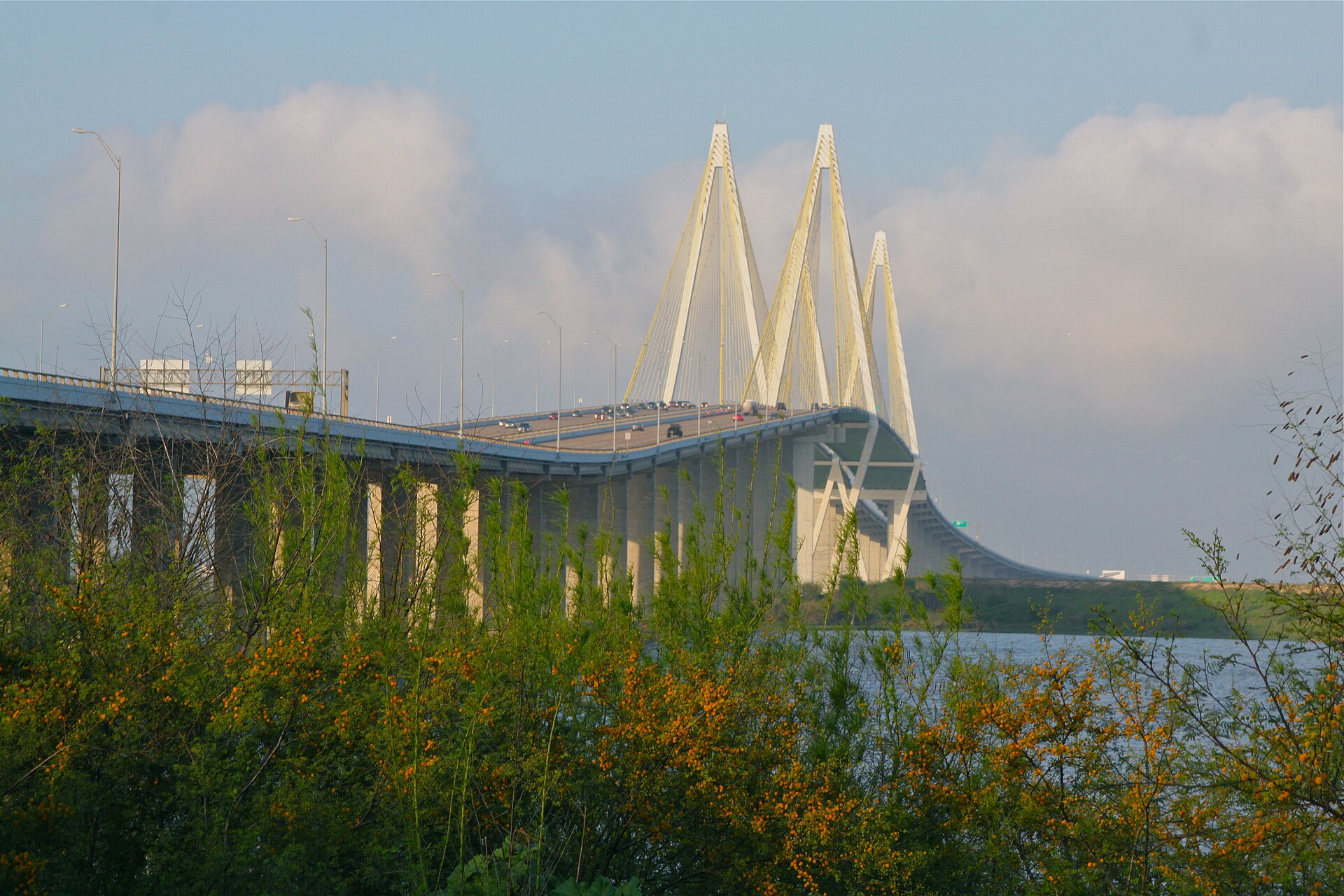
The refinery lights seen from the Fred Hartman Bridge are also a lesson in chemistry and energy. Follow ethane through a cracker and out the gate, and the glow turns into a lesson in where energy goes.
Mid-August, and the nights do not cool off. You drive back over the Fred Hartman Bridge after dark, up the long cable-stayed climb from La Porte, and at the top the whole east side of the county opens out below you lit like a city that is not there. There is no city. There are the plants, miles of them, every column and pipe rack and stair tower strung with lamps, the furnace stacks standing in their own glow, the tank farms dark and round between. From the top of the bridge on an August night Baytown does not look like a town that makes fuel. It looks like a town that makes light.
That is closer to the truth than it sounds, and I want to take it seriously, all the way down to the atoms, because what happens inside the brightest of those buildings is one of the strangest and most useful things people have ever learned to do, and almost nobody who lives in sight of it has had it described.
The building is an ethylene plant, what the industry calls a cracker, and the town has a large one. Its raw material is about as simple as a hydrocarbon gets: ethane, two carbons and six hydrogens, a gas that comes up out of the ground with natural gas and is separated out and, some of it, stored in the salt caverns under Mont Belvieu and piped down to the channel. Ethane is stable. It is content to be ethane. Left alone it would sit in a pipe for a thousand years. The cracker's whole purpose is to make it discontent.
Fire in the tubes

It does this with fire. The ethane is mixed with steam and sent through a bundle of tubes hung inside a furnace the size of a church, and the furnace is fired from the floor and from the walls until the tubes glow and the gas inside them reaches something like eight hundred and fifty degrees Celsius, well past the melting point of aluminum. The steam does no chemistry of its own; it is there to thin the crowd, so that the ethane molecules are farther apart and less likely to find each other and stick, and to keep the inside of the tubes from furring up with carbon. At that temperature the molecule cannot hold itself together. What happens next happens in a chain. A few molecules break clean in two at the carbon-carbon bond, and the halves, hungry for an electron, tear a hydrogen off the nearest whole ethane. The ethane that lost a hydrogen is now unstable in its own turn, and it settles the matter by shedding a second hydrogen and doubling the bond between its carbons, and the hydrogen it shed goes off to tear one from the next molecule. So it runs, a fraction of a second, less than the time it takes you to blink, through the whole bundle of tubes. Add it all up and the ledger is simple. Ethane has become ethylene and hydrogen. C2H6 has become C2H4 and H2. Nothing has been created and nothing destroyed. Eight atoms went in and eight atoms came out. They are only arranged differently, and the difference is the whole modern world.
Then, immediately, the gas is cooled, slammed down in temperature in a set of exchangers just past the furnace, because at eight hundred and fifty degrees the reaction will not stop where you want it. Left another half second the molecules keep breaking, into methane, into acetylene, into soot. The art of a cracker is not the heat. Anyone can make heat. The art is the timing: exactly this hot, for exactly this long, and then stop. And even done right, a little carbon lays itself down inside the tubes every hour, so that every few weeks a furnace has to be taken off feed and burned clean with steam and air before it goes back to work. The night-shift operator watching the furnace readings is doing something closer to what a cook does at a hot stove than to what most people picture when they hear the word refinery. He is watching for the moment.
Cracked gas
What comes out of the furnace is a mess, and honestly named: cracked gas. It is ethylene and hydrogen and unconverted ethane and methane and propylene and a dozen other things. The rest of the plant, the tall columns you see from the bridge, is a sorting machine. The gas is compressed, scrubbed, dried, and then chilled, in stages, colder and colder, until the components turn to liquid one at a time and can be drawn off, each at its own temperature, the way frost forms on a windowpane before ice does. The hydrogen and the methane, the lightest and hardest to catch, are taken off first, at the cold end of the plant, a hundred degrees below zero Celsius and colder. Ethylene is split from ethane further along, in a column that is still far below any winter the bay has seen, but not so deep in the cold. The ethane goes back to the furnace to try again. The hydrogen goes off to be used elsewhere. The ethylene goes out by pipeline, a clear gas under pressure, to the next plant, or the next, on the channel or up the road or across the state.
So the furnace is the fire, and the columns are the cold, and between them the plant runs a temperature swing that nothing else in the county comes near, from the heat of a glowing furnace tube to colder than any winter that has ever touched the bay, all inside steel, all so that two hydrogens can be persuaded to leave.
Now follow the ethylene out the gate.
Most of it goes to be made into polyethylene, which is what you get when you convince ethylene molecules to join hands in a line, each one opening its double bond to grab the next, thousands of them, until you have a chain long enough to be a solid. That is the grocery bag. That is the milk jug, the shampoo bottle, the water pipe under the street, the film over the leftovers, the lid on the cup, the coating inside the carton. Some goes to be made into ethylene oxide and then ethylene glycol, which is the antifreeze in your radiator and also one of the two building blocks of the polyester in your shirt and the plastic in the water bottle in your hand. Some goes, by way of chlorine, into PVC, which is the pipe and the siding and the insulation on the wire in the wall. Some becomes styrene and then polystyrene, the foam cup and the packing around the television. Ethylene is the most-produced organic chemical on earth, and it is that because it is the most useful starting point ever found: two carbons with a bond that wants to open. Look around the room you are sitting in and try to find something that did not, at some point, pass through a double bond like that. The screen you are reading on did.
That is the industry story, and it is a true one, but it is not the one I came up the bridge for. The one I came for is about the light.
Where the energy is

Where is the energy in any of this? Not in the atoms. A carbon atom in a grocery bag is the same carbon atom it was in the furnace and the same it was in the ground, and it will be the same in whatever comes after. The energy is in the bonds, in the arrangement, in how tightly and in what pattern the atoms are holding on to one another. Pulling two hydrogens off an ethane molecule costs energy; the furnace pays it, by burning fuel gas under the tubes. Some of what the furnace pays is kept, for a while, in the double bond, which is a more restless thing than the single bond it replaced, and that restlessness is the entire reason ethylene is worth making. The rest of what the furnace pays leaks. It leaks as heat off the stacks, as the glow at the furnace throat, as the steam plume, and, after a long detour through a turbine and a wire, as the lamps on every column and stair tower you can see from the bridge. The light is the leak. What you are looking at from the top of the climb is the part of the energy that got away, and it is the smaller part, and the plant would rather it were smaller still.
The part that does not get away is the product. At the next plant down the pipeline the restless bond does what it was made to do: it opens, grabs the next molecule, and closes into a chain, and in closing it gives back a share of what the furnace paid, as heat, which that plant has to carry off in its own cooling towers. What stays in the polyethylene is the ordinary energy of carbon and hydrogen holding on to one another, the same energy that was in the ethane in the ground, now arranged in a line ten thousand atoms long instead of a molecule of eight. The arrangement is the product. It is what makes the bag strong enough to carry the milk, and the pipe under the street able to hold its shape for a century. A polyester shirt is the same energy in a different pattern. When any of it is finally burned or buried or breaks down, the pattern comes apart and the energy leaves the rest of the way, as heat, as a little light, and the atoms go back into the air and the ground with nothing lost but the order.
That is what a town like this does, stripped of every slogan for and against it. It spends energy to rearrange atoms into patterns that are useful, and keeps as much of the spending inside the pattern as it can, and lets the rest go as light over the bay. A town that makes fuel is a coarse description. A town that takes things apart and puts them back together in a more useful order, at a cost, and shows the cost on the skyline every night, is closer. The glow you see from the bridge is the receipt.
The peach on the table

There is one more turn in this, and it is the one that makes the whole thing worth a night on the bridge. Ethylene, the molecule the furnace makes, is not an industrial invention. It is a hormone. Plants make it, in tiny amounts, and use it to tell a fruit to ripen and a leaf to let go in the fall and a flower to open. A peach in a bowl on a kitchen table in Baytown is making the same molecule the plant across town is making, two carbons and four hydrogens, identical to the last electron, and using it to turn itself sweet. The tree does it in the dark, with enzymes, at room temperature, one molecule at a time. The plant does it with fire, by the ton. Neither of them invented it. The molecule was there in the chemistry of carbon before there were trees or towns, waiting to be found from both directions, and it was.
A young operator on the night shift at an ethylene plant, looking at a furnace outlet temperature on a screen, is a collection of atoms that were themselves made in stars, using the energy in one set of bonds to break another, so that other collections of atoms can drink from a bottle or drive on a tire or lie under a hospital blanket. The universe, at that desk, is rearranging itself with a coffee in one hand. It does not feel grand. It feels like Tuesday.
The bridge descends. The light falls away behind you into the mirror of the bay, and the flare is small, and the furnaces glow orange at their throats, and a night shift is at work in there watching for the moment. At the bottom of the bridge you turn toward home, and for a mile or two the plant is in the rearview mirror, a city that is not there, every lamp on it a little of what the furnace could not keep.
Read next: The plants, plainly, Where to watch the sunset.
En español
Un pueblo que se convierte en luz
A mediados de agosto las noches no refrescan. Usted regresa de noche por el Fred Hartman Bridge, subiendo la larga pendiente de cables desde La Porte, y en lo alto todo el lado este del condado se abre allá abajo, iluminado como una ciudad que no existe. No hay ciudad. Hay plantas, millas de plantas, con cada columna, cada soporte de tuberías y cada torre de escaleras cubiertos de lámparas, las chimeneas de los hornos de pie dentro de su propio resplandor y los tanques oscuros y redondos entre unas y otras. Desde lo alto del puente, en una noche de agosto, Baytown no parece un pueblo que hace combustible. Parece un pueblo que hace luz.
Eso se acerca más a la verdad de lo que suena, y quiero tomarlo en serio, hasta los átomos, porque lo que ocurre dentro del más iluminado de esos edificios es una de las cosas más extrañas y útiles que las personas han aprendido a hacer, y casi nadie que vive a la vista de ese edificio ha tenido quien se lo describa.
El edificio es una planta de etileno, lo que la industria llama un craqueador, y el pueblo tiene uno grande. Su materia prima es lo más sencillo que puede ser un hidrocarburo: etano, dos carbonos y seis hidrógenos, un gas que sale de la tierra junto con el gas natural, se separa y, en parte, se almacena en las cavernas de sal bajo Mont Belvieu y se envía por tubería hasta el canal. El etano es estable. Está conforme con ser etano. Si se le dejara solo, pasaría mil años dentro de un tubo. Todo el propósito del craqueador es dejarlo inconforme.
Fuego en los tubos
Lo hace con fuego. Se mezcla el etano con vapor y se envía por un haz de tubos colgados dentro de un horno del tamaño de una iglesia. El horno se enciende desde el piso y desde las paredes hasta que los tubos se ponen al rojo y el gas de adentro llega a unos ochocientos cincuenta grados Celsius, mucho más que el punto de fusión del aluminio. El vapor no hace química propia; está ahí para aclarar la multitud, de modo que las moléculas de etano queden más separadas y tengan menos probabilidad de encontrarse y pegarse, y para evitar que el interior de los tubos se cubra de carbón. A esa temperatura la molécula no puede sostenerse a sí misma. Lo que sigue ocurre en cadena. Unas cuantas moléculas se parten limpiamente en dos en el enlace carbono-carbono, y las mitades, hambrientas de un electrón, le arrancan un hidrógeno al etano entero más cercano. El etano que perdió un hidrógeno queda a su vez inestable, y resuelve el asunto soltando un segundo hidrógeno y duplicando el enlace entre sus carbonos, y el hidrógeno que soltó se va a arrancar uno de la siguiente molécula. Así corre, en una fracción de segundo, menos de lo que tarda un parpadeo, por todo el haz de tubos. Sumado todo, la cuenta es sencilla. El etano se ha convertido en etileno e hidrógeno. C2H6 se ha vuelto C2H4 y H2. No se creó nada y no se destruyó nada. Entraron ocho átomos y salieron ocho átomos. Solo están ordenados de otra manera, y esa diferencia es todo el mundo moderno.
Enseguida el gas se enfría de golpe, en una serie de intercambiadores justo después del horno, porque a ochocientos cincuenta grados la reacción no se detiene donde uno quiere. Si se deja medio segundo más, las moléculas siguen rompiéndose, en metano, en acetileno, en hollín. El arte de un craqueador no es el calor. Cualquiera puede hacer calor. El arte es el momento justo: exactamente esta temperatura, exactamente este tiempo, y detenerse. Y aun cuando se hace bien, cada hora se deposita un poco de carbón dentro de los tubos, de modo que cada pocas semanas hay que sacar un horno de servicio y limpiarlo quemando el depósito con vapor y aire antes de volver a ponerlo a trabajar. El operador del turno de noche que vigila las lecturas del horno hace algo más parecido a lo que hace un cocinero ante una estufa muy caliente que a lo que la mayoría imagina al oír la palabra refinería. Está pendiente del instante.
El gas craqueado
Lo que sale del horno es una mezcla, y con razón se llama gas craqueado. Contiene etileno, hidrógeno, etano sin convertir, metano, propileno y una docena de cosas más. El resto de la planta, las columnas altas que se ven desde el puente, es una máquina clasificadora. El gas se comprime, se lava, se seca y luego se enfría por etapas, cada vez más, hasta que los componentes se vuelven líquidos uno a uno y pueden extraerse cada uno a su propia temperatura, como se forma la escarcha en un vidrio antes que el hielo. El hidrógeno y el metano, los más ligeros y difíciles de atrapar, salen primero, en el extremo frío de la planta, a cien grados bajo cero Celsius y menos. El etileno se separa del etano más adelante, en una columna que sigue estando muy por debajo de cualquier invierno que haya conocido la bahía, pero no tan profundo en el frío. El etano regresa al horno para intentarlo de nuevo. El hidrógeno se va a usarse en otra parte. El etileno sale por tubería, un gas transparente a presión, hacia la siguiente planta, o la otra, en el canal, carretera arriba o a través del estado.
Así que el horno es el fuego, las columnas son el frío, y entre los dos la planta maneja un vaivén de temperatura que nada más en el condado se le acerca, del calor de un tubo de horno incandescente a un frío mayor que cualquier invierno que haya tocado la bahía, todo dentro de acero, todo para que dos hidrógenos se dejen convencer de irse.
Ahora siga al etileno por el portón.
La mayor parte se convierte en polietileno, que es lo que resulta cuando se convence a las moléculas de etileno de tomarse de las manos en una línea, cada una abriendo su doble enlace para agarrar a la siguiente, miles de ellas, hasta formar una cadena lo bastante larga para ser un sólido. Eso es la bolsa del supermercado. Es el envase de leche, la botella de champú, el tubo de agua bajo la calle, la película sobre las sobras, la tapa del vaso, el recubrimiento interior del cartón. Una parte se convierte en óxido de etileno y luego en etilenglicol, que es el anticongelante del radiador y también uno de los dos componentes del poliéster de su camisa y del plástico de la botella de agua que tiene en la mano. Otra parte, por medio del cloro, pasa a ser PVC, que es el tubo, el revestimiento exterior y el aislante del cable dentro de la pared. Otra se vuelve estireno y luego poliestireno, el vaso de espuma y el empaque alrededor del televisor. El etileno es el producto químico orgánico que más se produce en la Tierra, y lo es porque es el punto de partida más útil que se ha encontrado: dos carbonos con un enlace que quiere abrirse. Mire alrededor del cuarto donde está sentado e intente encontrar algo que no haya pasado, en algún momento, por un doble enlace así. La pantalla en la que lee pasó.
Dónde está la energía
¿Dónde está la energía en todo esto? No en los átomos. Un átomo de carbono en una bolsa de supermercado es el mismo que estaba en el horno y el mismo que estaba bajo tierra, y será el mismo en lo que venga después. La energía está en los enlaces, en el arreglo, en qué tan fuerte y con qué patrón los átomos se sujetan entre sí. Quitarle dos hidrógenos a una molécula de etano cuesta energía; la paga el horno, quemando gas combustible bajo los tubos. Parte de lo que paga el horno se conserva, por un tiempo, en el doble enlace, que es más inquieto que el enlace sencillo al que reemplazó, y esa inquietud es toda la razón por la que vale la pena fabricar etileno. El resto de lo que paga el horno se escapa. Se escapa como calor por las chimeneas, como resplandor en la garganta del horno, como columna de vapor y, tras un largo rodeo por una turbina y un cable, como las lámparas de cada columna y cada torre de escaleras que se ven desde el puente. La luz es la fuga. Lo que usted ve desde lo alto de la subida es la parte de la energía que se escapó, que es la parte más pequeña, y la planta preferiría que fuera todavía más pequeña.
La parte que no se escapa es el producto. En la siguiente planta, al final de la tubería, el enlace inquieto hace aquello para lo que fue creado: se abre, agarra a la siguiente molécula y se cierra en una cadena, y al cerrarse devuelve una parte de lo que pagó el horno, en forma de calor, que esa planta tiene que sacar en sus propias torres de enfriamiento. Lo que queda en el polietileno es la energía ordinaria del carbono y el hidrógeno sujetándose entre sí, la misma energía que había en el etano bajo tierra, ahora acomodada en una línea de diez mil átomos en lugar de una molécula de ocho. El arreglo es el producto. Es lo que hace que la bolsa aguante el peso de la leche y que el tubo bajo la calle conserve su forma durante un siglo. Una camisa de poliéster es la misma energía en otro patrón. Cuando todo eso se quema, se entierra o se descompone por fin, el patrón se deshace y la energía termina de salir, como calor, como un poco de luz, y los átomos regresan al aire y a la tierra sin que se pierda nada más que el orden.
Eso es lo que hace un pueblo como este, sin ninguna consigna a favor ni en contra. Gasta energía para reacomodar átomos en patrones útiles, conserva dentro del patrón todo lo que puede de ese gasto y deja ir el resto como luz sobre la bahía. Decir que es un pueblo que hace combustible es una descripción burda. Un pueblo que desarma las cosas y las vuelve a armar en un orden más útil, a un costo, y que muestra ese costo en el horizonte cada noche, se acerca más. El resplandor que se ve desde el puente es el recibo.
El durazno en la mesa
Hay un giro más, y es el que hace que valga la pena una noche en el puente. El etileno, la molécula que fabrica el horno, no es un invento industrial. Es una hormona. Las plantas lo producen en cantidades minúsculas y lo usan para decirle a un fruto que madure, a una hoja que se suelte en otoño y a una flor que se abra. Un durazno en un frutero, sobre la mesa de una cocina de Baytown, produce la misma molécula que produce la planta al otro lado del pueblo, dos carbonos y cuatro hidrógenos, idéntica hasta el último electrón, y la usa para volverse dulce. El árbol lo hace en la oscuridad, con enzimas, a temperatura ambiente, una molécula a la vez. La planta lo hace con fuego, por toneladas. Ninguno de los dos la inventó. La molécula estaba en la química del carbono antes de que hubiera árboles o pueblos, esperando que la encontraran desde los dos lados, y la encontraron.
Un operador joven del turno de noche en una planta de etileno, mirando en una pantalla la temperatura de salida de un horno, es un conjunto de átomos que se formaron en las estrellas, que usa la energía de un grupo de enlaces para romper otro, de modo que otros conjuntos de átomos puedan beber de una botella, rodar sobre una llanta o dormir bajo una cobija de hospital. El universo, en ese escritorio, se reordena a sí mismo con un café en la mano. No se siente grandioso. Se siente como un martes.
El puente baja. La luz queda atrás, cayendo sobre el espejo de la bahía, la antorcha es pequeña y los hornos brillan anaranjados en la garganta, y un turno de noche trabaja ahí dentro, pendiente del instante. Al pie del puente usted toma el camino a casa, y durante una milla o dos la planta queda en el espejo retrovisor, una ciudad que no existe, cada lámpara un poco de lo que el horno no pudo guardar.
Para seguir leyendo: Las plantas, explicadas con sencillez y Dónde ver el atardecer.