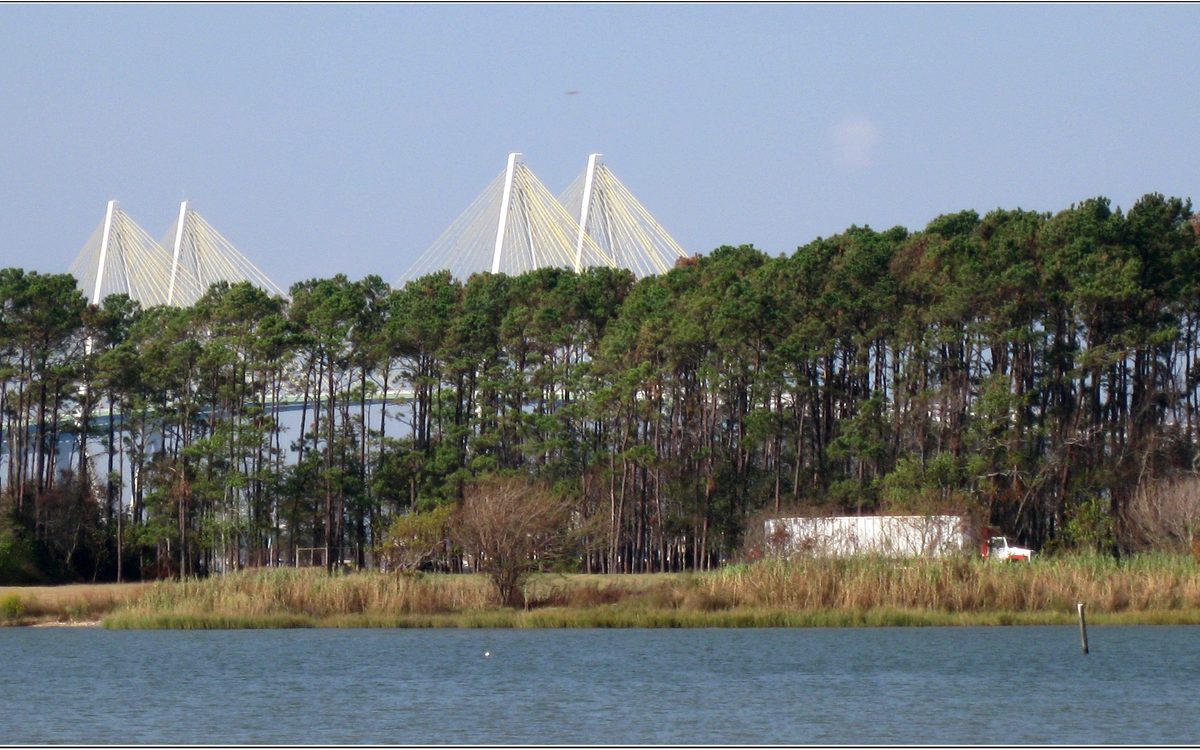
Twice a year the sun comes up as near to due east as it ever gets. Not a little north of east, the way it does all summer, and not a little south, the way it will all winter, but straight out of the bay, so that if you stand at the rail of the pier at Bayland Park around the twenty-second of September and hold a compass out over the water, the sun climbs up out of the place the needle says it should. That evening it goes down due west, on the far side of town. Day and night are as near to equal as they get. Astronomers call it the equinox, Latin for equal night, and it is one of the few things in the sky that a person with no instruments can check. You need a pier, a compass, and a morning off.
The Earth leans. It spins on an axis tilted about twenty-three and a half degrees from straight up, and it keeps that lean pointed at the same patch of stars all the way around the sun. For half the year the northern half of the planet is tipped toward the sun and we get the long days and the heat that runs the window units on every street in town. For the other half we are tipped away. Twice a year, in between, the lean is sideways to the sun, and on those two days the sun stands directly over the equator and rises and sets due east and due west for everybody, in Baytown and in Buenos Aires alike. The fall equinox is the one where the night pulls even, and then ahead. If you want to be exact, the day light and dark are truly equal comes a few days later, because the air bends the sun's light up over the horizon before the sun is really there. The sky gives us a little more than we are owed.
On the bay you can feel the turn before you can see it. The mornings are still warm, but the warmth comes later. The sun is lower over the water at seven than it was in July, and the light lies flatter on the bay, more silver than white. The pelicans are still working the shallows and the tankers are still coming up the channel, but the shadows of both are longer. The plant does not change. The flare is the same flare. What changes is the angle of the light that falls on it.
I want to stay with that flare, because this whole series is built on a thought that came to me watching it, and this is the essay where I owe you the thought.
There is a line from the astronomer Carl Sagan that most people have heard some version of. We are a way for the cosmos to know itself. He meant it plainly. The carbon in your body was made inside a star that burned out before the sun was born. The iron in your blood was cooked deep inside stars and thrown across space when those stars came apart. The hydrogen in the water in the bay is older than any of that; it dates from the first few minutes of everything, before there were stars at all. None of this is poetry. Starlight, spread out through a prism, has dark lines in it, and the lines are the fingerprints of the elements, the same fingerprints a lamp gives off on a laboratory bench. The light says what the stars are made of. The nuclear physics says how they made it. They agree. A person, then, is a small quantity of very old star material arranged, over a great deal of time, into something that can stand on a pier and work out why the sun is rising where it is. The universe, in the form of you, is looking at itself.
That is one vocabulary, and it is true, and it belongs to the sky.
The second vocabulary is older. Aristotle, in the book we call the Metaphysics, needed a word for the difference between what a thing could be and what it is actually doing, and no such word existed in Greek, so he built one. Energeia. It is made of the word for work, ergon, with a prefix that means roughly in or at. Being-at-work. A pile of lumber is a house in potential; the house, standing, is the lumber at work. He used the word for the highest thing he could think of, thought thinking itself, and he would have been surprised to learn that some twenty-three centuries later it would come down to us as energy and mean the number on the gas bill. The road from his word to ours is long. It passed through Latin into English as a word for vigor in speech, and not until 1807 did an English physicist named Thomas Young use it for the thing a moving weight has, the thing we mean now. But the root is still in there. Energy is not a substance you could keep in a jar; it is a way of describing what a thing is doing, or could do, and the difference between those two, potential and actual, is the difference Aristotle needed the word for.
Now the third vocabulary, which has no famous name attached, because the people who speak it work nights.
Somewhere on the channel, on any night, somebody is standing at the top of a distillation column. The column is a steel tower, tall as an office building, full of trays, and its job is the simplest and oldest job in the refinery. Crude oil, heated in a furnace until much of it is vapor, comes in low on the tower. It is thousands of different molecules that boil at different temperatures, the small ones easily and the big ones only when pushed, and so as the vapor rises through the tower and cools, the heavy stuff condenses on the low trays and the light stuff climbs higher. Each tray is a shallow pool of liquid the rising vapor bubbles through, leaving a little of its heavy part and taking a little of the light, and there are dozens of trays, so the sorting happens dozens of times over. Gas off the top. Then the naphtha that becomes gasoline. Then kerosene, then diesel, then the heavy oils, then what will not boil at all, which drains out the bottom to be worked further, and some of it ends up as the road you drove in on. The operator does not do the separating. Heat does, and the plain fact that different molecules let go at different temperatures. The operator's job is to know what is happening behind a wall of steel, at three in the morning, without being able to see any of it.
So they read. Temperature at each tray, which should fall smoothly from bottom to top and tells a story when it does not. Pressure. The level in the drum. The flow out of each draw. A hundred numbers on a screen in the control room, and a few dozen gauges on the tower itself that somebody still climbs to look at with their own eyes, because a screen is a report and a gauge is a witness. From those numbers the operator builds a picture of a process no one has ever watched directly, and then adjusts it, a valve here, a setpoint there, so that the picture stays the way it should. When something drifts, they hear it before the alarm does, the way you can tell what a car is doing from the sound of it in the next room.
Stand back from those three and look at them together. The astronomer says: the universe has arranged some of its own material into things that can know it. The philosopher says: what is real is what is at work, and knowing is the highest work there is. The operator says nothing, because they are busy, but what they are doing is this: they are a piece of the world that has learned to read another piece of the world so closely that it can keep it in balance in the dark.
I do not think these are three different subjects. I think they are the same subject in three vocabularies, and the plant is where I learned to see that.
Consider what is actually in the tower. The oil that went in is sunlight, and I mean the word. Some hundreds of millions of years ago, light left the sun, crossed ninety-three million miles in about eight minutes, and fell on a shallow sea where microscopic living things caught it and used it to build themselves. They died, sank, were buried, were pressed and cooked for longer than anyone can picture, and became the dark liquid a ship brings up the channel. The energy in that barrel was put there by a star. The plant does not make energy. Nothing makes energy. The plant takes an old parcel of sunlight, unpacks it, sorts it, rearranges its atoms, and sends it out to become the kerosene in a jet, the plastic in a hospital's IV line, the gasoline in the truck that brings the operator home at seven. Conservation of energy, the thing on the poster in the eighth-grade classroom, is what the tower is doing all night, in steel, at a few hundred degrees. Potential going to actual. Energeia.
And the person on top of the tower, reading it, is made of the same stuff. The carbon in the operator's hands and the carbon in the pipe are both from stars. They are both, in Sagan's sense, the universe. One has been arranged into a molecule of kerosene, and one into a person who can tell, from a pressure reading and the sound of a valve, whether that kerosene is about to be kerosene or about to be trouble. The difference between them is not the material. It is the arrangement, and what the arrangement can do. One is fuel. The other is the fuel looking at itself.
It is the plainest thought I have, and there is nothing mystical in it. The world fuels the world; a small part of the world, made of the same atoms, has learned to watch and understand the rest of it; and that watching is the fueling become aware of itself. The town is where that happens on an industrial scale. The rockets and the hospitals and the phone in your hand all start in a drum on the channel, and so does the knowledge of how to make them. They come off the same tower.
I learned this standing at the rail at Bayland Park after dark, watching the flare, which is the plant saying out loud what it is doing, and thinking about the person who could read it. I thought: the atoms in that flame are older than the Earth, and the light in it is sunlight that has been waiting under the ground since long before there were people to see it. And somebody up there knows exactly what it is and exactly why it is burning, and that somebody is made of the same light.
On the morning of the equinox the sun comes up due east, and its light crosses the bay and hits the tower before it hits the town. For a moment the whole steel column is lit from the side, gold, every tray's shadow drawn on the one below, and the small figure at the top rail, coming to the end of a twelve-hour night, turns to look at it. The star that made the oil is rising over the oil. The star material that reads the gauges is watching the star. Day and night are equal, for once, and the light is exactly level with the water.