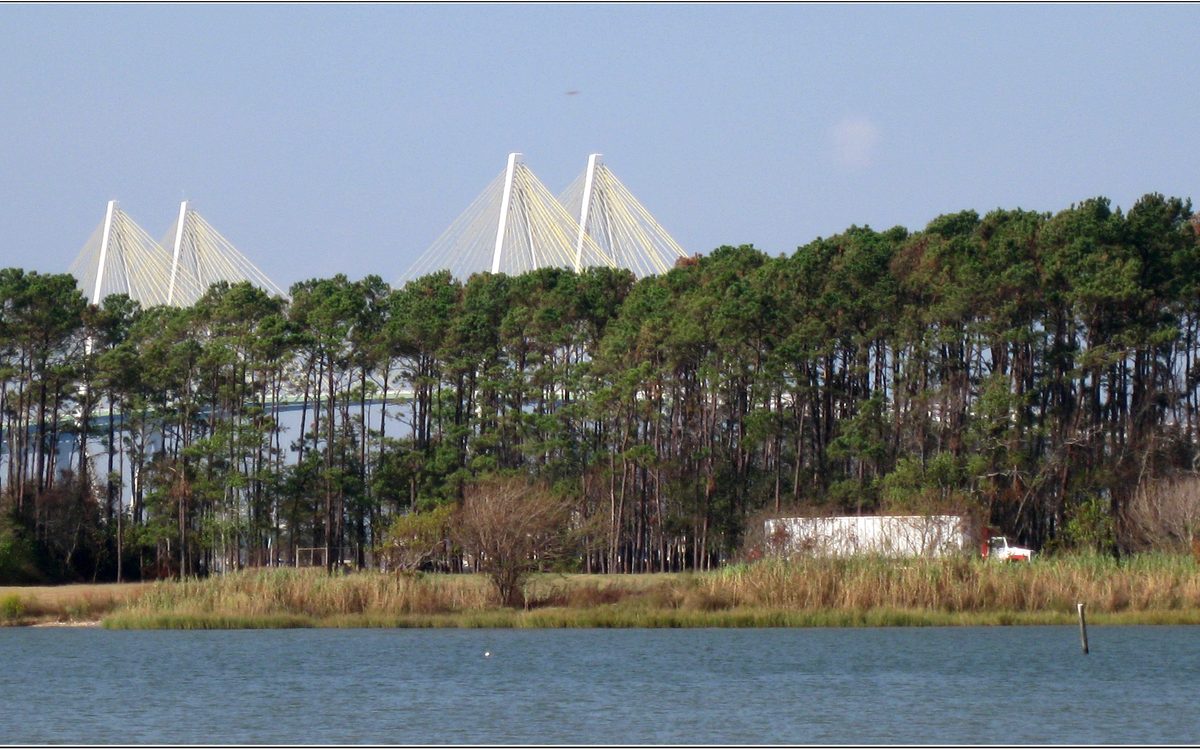
Texas existed long before oil became the state's shorthand, and Baytown's shoreline did too. Strip away the modern industrial landscape and what is left is cattle, cotton, water, horsepower and the energy economy that came first.
On the second of March the flags go up along the older streets, and for a good part of the town it is an ordinary working day. Independence Day in Texas is a working holiday. That fits the day it remembers. The men who signed the declaration at Washington-on-the-Brazos in 1836 did it in an unfinished building with cloth tacked over the window openings, in a cold wind, with the Alamo already under siege a few days' ride to the west. Nobody took the day off. They wrote it, signed it, and went back to the war. Seven weeks later the war was decided in a field just across the channel from here, in about the time it takes to eat lunch.
What they declared independent was not a place that looks like this one. It helps to stand on the pier at Bayland Park at dusk and try to see it. Take away the tankers riding at anchor. Take away the towers on the far shore and the orange they throw onto the underside of the clouds. Take away the bridge and its cables. Take away, if you can manage it, every barrel of oil that has ever come out of the ground in this county, because in 1836 not one had. What is left is the bay. Brown water, a low green shore, a line of pelicans, and the wind. That was Texas. That was most of what there was.
The republic that lasted nine years, and the state that followed it, ran on three things: cattle, cotton, and water you could float a ship on. None of them is a fuel in the way we use the word. All of them are energy.
Cattle, cotton, and the bay

Start with the cattle, because they were here first and they were nobody's idea. The longhorn was a Spanish animal gone wild, a few centuries of feral breeding in the brush country south and west of here. It could walk a long way on bad grass and it did not need anybody. When the Civil War ended there were something like five million of them loose on the range and no market nearer than the railheads in Kansas, so the market was walked to. A drive was a machine for moving sunlight north. Grass took the sun, cattle took the grass, and the herd carried it up the trail at the pace of a walking cow, and somebody in Chicago ate it. That is a supply chain. It moved at the pace of a walking herd, ten to fifteen miles a day, and it could only move in the months when there was grass along the way, because the fuel had to be found on the road.
Cotton was the money. It grew in the river bottoms, the Brazos and the Colorado and the Trinity, on land cleared by hand and, before 1865, worked by people who had no say in the matter. The bales came down to the coast in wagons and later on rails, and they went out through Galveston, which for a good stretch of the nineteenth century was the biggest city in Texas and its front door. A bale of cotton on a Galveston wharf was bound for a mill in England or New England, and the ship that took it there was pushed by wind, and later by coal. Texas cotton was spun by somebody else's energy. The state grew the fiber. The power to turn it into cloth lived in another country.
And the bay. Galveston Bay was the reason the coast was worth anything. It was shallow and full of oyster reef, and the deep channel up to Houston did not exist yet, but it was water you could put a schooner on, and a schooner beat a wagon every time. The little landings along the shore, the ones whose names are still on the road signs, were where the interior met the world. A man named Lynch was running a ferry across the San Jacinto at Lynchburg by 1822, fourteen years before there was a republic to put it in, and it was toward that ferry that both armies were moving in April of 1836 when they found each other instead. The county still runs a boat across the same water, free, a few minutes each way. Before the channel was dredged and opened in 1914, the world came as far as the bay would let it, and the bay decided a lot.
The horse and the gallon
What did not exist, in any form we would recognize, was the thing this town is built on. Nobody had a fuel in that sense — a store of energy dense enough to carry, burn on demand, and bank against a day the grass didn't grow. They had wood for the steamboat boilers and the kitchen stove. They had tallow for candles and a little whale oil for the lamp if they were prosperous. They had the horse, which is a machine for turning grass into work, and the ox, which is the same machine geared lower. They had their own backs. When a person in the republic wanted something moved, or lifted, or pumped, or cut, the energy for it had to come out of a living body that had eaten something that had grown that year. Nothing was banked. There was only what the grass could give between one spring and the next.
It is hard now to feel how small that account was. James Watt, selling steam engines to men who owned horses, needed a way to say what one of his engines could do, and he settled on the work a good horse could keep up all day: thirty-three thousand foot-pounds every minute, one horsepower. A gallon of gasoline, burned, holds about as much work as that horse can do in four or five long days. The horse has to eat the whole time. The gallon sits in a can. That is the entire distance between the republic and the town, and it is a distance of one gallon.
Hold onto the gallon, because it explains the shape of the old state. Everything was slow because everything ran at the speed of a muscle. Towns were small because a town can only be as big as the food a wagon can bring it. Houses were built of what grew nearby. A trip to Galveston was a trip. Nobody in Texas in 1850 could have told you what a barrel was, in the sense we mean it, because the unit had no reason to exist.
The first petroleum most Texans ever met came in a can. After the Pennsylvania wells began flowing in 1859, kerosene moved down the rivers and along the coast and into the general stores, and it was cleaner than tallow and cheaper than whale oil, and a family that had gone to bed at dark could read past it. That was the whole of the oil business here for forty years: a lamp, filled from a can, shipped from somewhere else. Nobody thought to look under their own feet.
Spindletop and Goose Creek

Then the ground opened.
The first big one was not here. It was near Beaumont, at a low rise called Spindletop, in January of 1901. The drillers had been laughed at for years for thinking there was oil under a salt dome. When they got down a little over a thousand feet the well blew the pipe out of the hole and threw a column of oil higher than the derrick, and it ran that way for nine days before anybody could cap it. The estimates of what came out of that one hole vary, but the number people usually give is on the order of a hundred thousand barrels a day. Do the arithmetic against Watt's horse and it comes out somewhere absurd: in a single week one hole in the ground let loose more usable energy than every horse and mule in the state could have produced in the same week, many times over. Nothing was the same after that. Not the price of a lamp. Not the map.
Goose Creek came a few years behind. Oil was found around the creek early in the new century, and the field boomed in 1916 and 1917, and then something happened here that had not happened much anywhere: they drilled in the water. The derricks stood out in the creek and in Tabbs Bay on pilings, with the tide moving underneath them. People who study the industry count it as one of the first fields worked offshore, in the crude and literal way of the time. And as the oil came up the ground went down, because it does, and the shoreline you walk on today is lower than the one the drillers stood on.
The refinery followed the field. Humble Oil started building it in 1919 on the flat land along the channel, because the oil was here and the water was here, and it was running by 1920, and it has not stopped since. Everything that came after is a consequence. The town, the schools, the hospital on Garth Road, the bridge, the high schools, the hotels that fill when the turnaround crews come in: all of it is the long shadow of a hole in the ground.
Where the energy was kept

The republic those fifty-nine men declared did not lack energy. It was full of energy. It was grass and sun and salt water and muscle, and every bit of work done in it was done by something alive. What the gusher changed was not whether Texas had energy but where the energy had been kept. Oil is what is left of a sea that lived and died a few hundred million years ago and was buried before anything could eat it. The longhorn was spending that year's grass, and could spend it no faster than a stomach allows. The well was spending a harvest gathered before there was a bay here, or a shore, or anything on it that could walk, and it could spend it as fast as a pipe would carry it. I do not know a better way to say the difference between the state before and the state after than that a person can now drive to Galveston and back before lunch.
It is also why the day is a working holiday. The men at Washington-on-the-Brazos signed for a country that had to be worked to exist, and that has not changed. The plant on the channel is a place where a great many people go every morning and every night to keep a fire burning that would go out without them. The republic asked the same thing. It just asked it of a mule.
At dusk on the second of March somebody on the older streets takes the flag back in off the porch, and the shift-change traffic comes out through the gate with its headlights on, and the tide moves in Tabbs Bay over the ground where the derricks stood. The water does not know what year it is. It was here before the oil and before the flag, and of the three things the old state ran on it is the one still doing its job.
Read next: A short history of Baytown, The San Jacinto day.
En español
Texas antes del petróleo
El dos de marzo suben las banderas en las calles más viejas y, para buena parte del pueblo, es un día de trabajo como cualquier otro. El Día de la Independencia de Texas es un feriado en que se trabaja. Le queda bien al día que recuerda. Los hombres que firmaron la declaración en Washington-on-the-Brazos en 1836 lo hicieron en un edificio sin terminar, con tela clavada sobre los huecos de las ventanas, con viento frío y con el Álamo ya sitiado a unos días de viaje a caballo hacia el oeste. Nadie se tomó el día. La escribieron, la firmaron y volvieron a la guerra. Siete semanas después la guerra se decidió en un campo justo al otro lado del canal de aquí, en lo que tarda uno en almorzar.
Lo que declararon independiente no era un lugar que se parezca a este. Ayuda pararse en el muelle de Bayland Park al atardecer e intentar verlo. Quite los buques tanque anclados. Quite las torres de la orilla de enfrente y el naranja que echan sobre el vientre de las nubes. Quite el puente y sus cables. Quite, si puede, cada barril de petróleo que ha salido del suelo de este condado, porque en 1836 no había salido ni uno. Lo que queda es la bahía. Agua color café, una orilla verde y baja, una fila de pelícanos y el viento. Eso era Texas. Eso era casi todo lo que había.
La república, que duró nueve años, y el estado que le siguió, funcionaron con tres cosas: ganado, algodón y agua por la que pudiera flotar un barco. Ninguna de ellas es un combustible en el sentido en que usamos la palabra. Todas son energía.
Ganado, algodón y la bahía
Empecemos por el ganado, porque estuvo primero y no fue idea de nadie. El longhorn era un animal español vuelto salvaje, fruto de unos siglos de cría libre en el monte al sur y al oeste de aquí. Caminaba lejos con mal pasto y no necesitaba a nadie. Al terminar la Guerra Civil había unos cinco millones sueltos en el campo y ningún mercado más cerca que las estaciones de ferrocarril de Kansas, así que al mercado se llegaba a pie. Una arreada era una máquina para llevar luz del sol hacia el norte. El pasto tomaba el sol, el ganado tomaba el pasto, la manada llevaba todo eso por la ruta al paso de una vaca, y alguien en Chicago se lo comía. Eso es una cadena de suministro. Avanzaba al ritmo de una manada que camina, de diez a quince millas por día, y solo podía avanzar en los meses en que había pasto en el camino, porque el combustible había que encontrarlo por el camino.
El algodón era el dinero. Se daba en las vegas de los ríos, el Brazos, el Colorado y el Trinity, en tierra desmontada a mano y, antes de 1865, trabajada por personas a quienes nadie les pidió opinión. Las pacas bajaban a la costa en carretas y después en ferrocarril, y salían por Galveston, que durante buena parte del siglo diecinueve fue la ciudad más grande de Texas y su puerta de entrada. Una paca de algodón en un muelle de Galveston iba rumbo a una fábrica de Inglaterra o de Nueva Inglaterra, y el barco que la llevaba lo empujaba el viento y después el carbón. El algodón de Texas lo hilaba la energía de otros. El estado cultivaba la fibra. La fuerza para volverla tela vivía en otro país.
Y la bahía. La bahía de Galveston era la razón por la que la costa valía algo. Era poco profunda y estaba llena de arrecifes de ostras, y el canal hondo hasta Houston todavía no existía, pero era agua donde cabía una goleta, y una goleta le ganaba a una carreta siempre. Los pequeños embarcaderos de la orilla, los que todavía tienen su nombre en las señales del camino, eran donde el interior se encontraba con el mundo. Un hombre apellidado Lynch ya operaba un transbordador sobre el San Jacinto, en Lynchburg, en 1822, catorce años antes de que hubiera una república que lo contuviera, y hacia ese transbordador se movían los dos ejércitos en abril de 1836 cuando se encontraron el uno al otro. El condado todavía opera una lancha que cruza esa misma agua, gratis, unos minutos por viaje. Antes de que el canal fuera dragado y abierto en 1914, el mundo llegaba hasta donde la bahía lo dejaba, y la bahía decidía mucho.
El caballo y el galón
Lo que no existía, en ninguna forma que reconoceríamos, era aquello sobre lo que se levanta este pueblo. Nadie tenía un combustible en ese sentido: una reserva de energía lo bastante densa como para cargarla, quemarla cuando hiciera falta y guardarla para el día en que no creciera el pasto. Tenían leña para las calderas de los vapores y la estufa de la cocina. Tenían sebo para las velas y un poco de aceite de ballena para la lámpara, si les iba bien. Tenían el caballo, que es una máquina para convertir pasto en trabajo, y el buey, que es la misma máquina con una marcha más baja. Tenían su propia espalda. Cuando una persona de la república quería que algo se moviera, se levantara, se bombeara o se cortara, la energía tenía que salir de un cuerpo vivo que había comido algo que había crecido ese año. Nada estaba guardado. Solo había lo que el pasto podía dar entre una primavera y la siguiente.
Hoy cuesta sentir qué tan pequeña era esa cuenta. James Watt, que vendía máquinas de vapor a hombres que tenían caballos, necesitaba una forma de decir lo que podía hacer una de sus máquinas, y se decidió por el trabajo que un buen caballo aguanta todo el día: treinta y tres mil libras-pie por minuto, un caballo de fuerza. Un galón de gasolina, quemado, contiene más o menos el trabajo que ese caballo hace en cuatro o cinco días largos. El caballo tiene que comer todo el tiempo. El galón está en una lata. Esa es toda la distancia entre la república y el pueblo, y es una distancia de un galón.
Quédese con el galón, porque explica la forma del viejo estado. Todo era lento porque todo corría a la velocidad de un músculo. Los pueblos eran chicos porque un pueblo solo puede ser tan grande como la comida que una carreta le pueda traer. Las casas se hacían con lo que crecía cerca. Un viaje a Galveston era un viaje. Nadie en Texas en 1850 le habría podido decir qué era un barril en el sentido que hoy le damos, porque la unidad no tenía motivo para existir.
El primer petróleo que la mayoría de los texanos conoció llegó en una lata. Cuando empezaron a fluir los pozos de Pensilvania en 1859, el queroseno bajó por los ríos y por la costa y llegó a las tiendas de abarrotes, y era más limpio que el sebo y más barato que el aceite de ballena, y una familia que se acostaba al oscurecer pudo leer con él. Ese fue todo el negocio del petróleo aquí durante cuarenta años: una lámpara, llenada de una lata, traída de otra parte. A nadie se le ocurrió mirar bajo sus propios pies.
Spindletop y Goose Creek
Entonces se abrió la tierra.
El primer gran pozo no fue aquí. Fue cerca de Beaumont, en una loma baja llamada Spindletop, en enero de 1901. Los perforadores llevaban años de burla por pensar que había petróleo bajo un domo de sal. Cuando bajaron un poco más de mil pies, el pozo expulsó la tubería y lanzó una columna de petróleo más alta que la torre, y corrió así nueve días antes de que alguien pudiera taparlo. Los cálculos de lo que salió de ese solo hoyo varían, pero la cifra que suele darse es del orden de cien mil barriles al día. Haga la cuenta contra el caballo de Watt y sale algo absurdo: en una semana un solo hoyo en la tierra soltó más energía aprovechable que todos los caballos y mulas del estado en la misma semana, muchas veces más. Nada volvió a ser igual. Ni el precio de una lámpara. Ni el mapa.
Goose Creek vino unos años después. Se encontró petróleo alrededor del arroyo a principios del nuevo siglo, el campo explotó en 1916 y 1917, y entonces ocurrió aquí algo que casi no había ocurrido en ningún lado: perforaron en el agua. Las torres se alzaban en el arroyo y en la bahía de Tabbs sobre pilotes, con la marea moviéndose por debajo. Quienes estudian la industria lo cuentan entre los primeros campos trabajados mar adentro, a la manera tosca y literal de aquella época. Y a medida que subía el petróleo, el terreno bajaba, porque así pasa, y la orilla por la que usted camina hoy está más baja que aquella en la que se paraban los perforadores.
La refinería siguió al campo. Humble Oil empezó a construirla en 1919 en el terreno plano a lo largo del canal, porque el petróleo estaba aquí y el agua estaba aquí, y ya funcionaba en 1920, y no se ha detenido desde entonces. Todo lo que vino después es consecuencia. El pueblo, las escuelas, el hospital de Garth Road, el puente, las preparatorias, los hoteles que se llenan cuando llegan las cuadrillas de los paros programados: todo es la larga sombra de un hoyo en la tierra.
Dónde se guardaba la energía
La república que declararon aquellos cincuenta y nueve hombres no carecía de energía. Estaba llena de energía. Era pasto y sol y agua salada y músculo, y todo el trabajo que se hacía en ella lo hacía algo vivo. Lo que cambió el pozo surtidor no fue si Texas tenía energía, sino dónde estaba guardada. El petróleo es lo que queda de un mar que vivió y murió hace unos cientos de millones de años y quedó sepultado antes de que algo pudiera comérselo. El longhorn gastaba el pasto de ese año, y no podía gastarlo más rápido de lo que permite un estómago. El pozo gastaba una cosecha recogida antes de que hubiera aquí una bahía, o una orilla, o algo que caminara sobre ella, y podía gastarla tan rápido como la llevara un tubo. No conozco mejor manera de decir la diferencia entre el estado de antes y el de después que esta: hoy una persona puede ir en coche a Galveston y volver antes del almuerzo.
También es la razón por la que el día es un feriado en que se trabaja. Los hombres de Washington-on-the-Brazos firmaron por un país que tenía que trabajarse para existir, y eso no ha cambiado. La planta del canal es un lugar adonde mucha gente va cada mañana y cada noche a mantener un fuego que se apagaría sin ellos. La república pedía lo mismo. Solo que se lo pedía a una mula.
Al atardecer del dos de marzo, alguien en las calles viejas recoge la bandera del porche, el tráfico del cambio de turno sale por la puerta con los faros encendidos, y la marea se mueve en la bahía de Tabbs sobre el suelo donde estuvieron las torres. El agua no sabe en qué año está. Estaba aquí antes del petróleo y antes de la bandera, y de las tres cosas con que funcionó el viejo estado es la que sigue haciendo su trabajo.
Lea a continuación: Una breve historia de Baytown, El día de San Jacinto.