Goose Creek CISD Education Service Center
Hours
| Mon | 7:30 AM – 4:30 PM |
|---|---|
| Tue | 7:30 AM – 4:30 PM |
| Wed | 7:30 AM – 4:30 PM |
| Thu | 7:30 AM – 4:30 PM |
| Fri | 7:30 AM – 4:30 PM |
| Sat | Closed |
| Sun | Closed |
 Illustration
When school feels wrong, start by describing what changed instead of guessing why. Ask what the teacher sees, compare it with home, and request evaluation when a learning or disability concern needs a formal answer.
Parents are trained to look at school through outputs.
Grades.
Reading level.
Attendance.
Test scores.
Those matter.
There is another question:
Does somebody there know my child?
The CDC calls this school connectedness: a student's sense that adults and peers at school care about them as a person and about their learning. Stronger connectedness is associated with better health and school outcomes. The CDC lists lower rates of poor mental health, substance use and violence, and higher grades, better attendance and higher graduation rates, for students who feel connected.
That does not mean a child has to love school every morning.
Belonging is quieter.
A teacher pronounces the name correctly.
A coach notices the child is missing.
A librarian knows what shelf they head toward.
A friend saves a seat.
An adult can tell that today's "I'm fine" is not the usual version of fine.
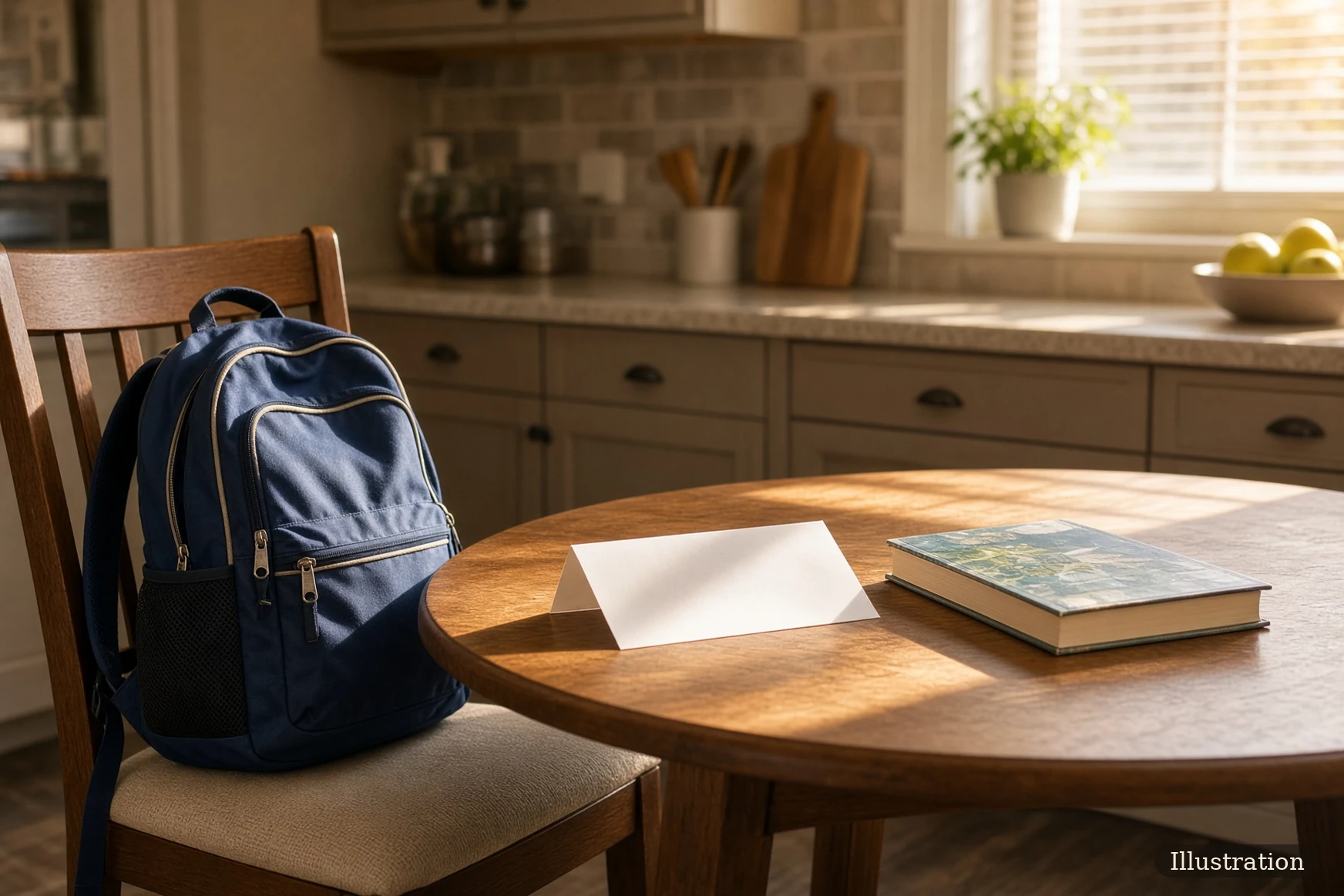
Difficulty can show up as: - falling grades; - stomachaches or headaches on school mornings; - refusing school; - anger after school; - missing work; - friendship trouble; - sleep changes; - a sudden loss of confidence; - behavior that looks very different from home; - a note folded into the backpack.
No one sign tells you the cause.
Start by comparing worlds.
Ask the teacher:
What are you seeing that I am not seeing at home?
And tell them what you are seeing too.
Sometimes the answer is academic.
Sometimes social.
Sometimes vision or hearing.
Sometimes anxiety.
Sometimes a child needs more challenge.
Sometimes they need more support.
Sometimes the week was simply bad.
A screening note can make a parent read ordinary paper as prophecy.
Vision needs follow-up.
Hearing.
Reading.
Attention.
Behavior.
Slow the moment down.
A screening is not a diagnosis.
A teacher observation is not a diagnosis.
A concern is a reason to look more closely.
For vision, hearing and dental screening information, see Teeth, eyes and ears.
For developmental concerns, see Is my child on track?.
Federal special-education law includes Child Find, which requires school systems to identify, locate and evaluate children with disabilities who may need special education and related services.
Parents do not need to know the final diagnosis before they are allowed to raise a concern.
A useful first step is to put the concern in writing and ask the school or district what evaluation process applies.
For younger children and local contacts, our milestones page explains Texas Early Childhood Intervention and the transition to school-district Child Find.
A school evaluation and a medical evaluation are not necessarily the same thing. They answer different questions and can sometimes inform one another.
The paperwork can become thick.
Keep seeing the child behind it.
Not every friendship problem is bullying.
Children fall out, change groups, say hurtful things, make up and move on.
Bullying involves a pattern of unwanted aggressive behavior and a real or perceived power imbalance; when safety, threats or repeated targeting are involved, adults need to step in.
StopBullying.gov, the federal site, defines bullying as unwanted, aggressive behavior among school-aged children that involves a real or perceived power imbalance, and adds that the behavior happens more than once or has the potential to. It names three kinds: verbal, like name-calling and threats; social, like leaving someone out on purpose or spreading rumors; and physical, like hitting, pushing or damaging a child's things. It happens online too. A single mean comment is unkind and worth a talk, but it is not the same problem as a child who is targeted again and again by someone with more power.
If your child says something happened, begin by listening before deciding exactly what to call it.
Ask: - What happened? - Has it happened before? - Who was there? - Do you feel safe going back? - What do you want me to know that I haven't asked?
Then use the school's current reporting process when adult intervention is needed.
School will generate documents about your child for years.
Scores.
Attendance.
Plans.
Accommodations.
Discipline.
Awards.
Those records matter.
They are not the whole person.
The parent has the harder job:
read the paper,
and keep seeing the child behind it.
For district boundaries, calendars and practical school information, see Schools in Baytown.
Three districts serve the families this section covers. The Goose Creek CISD Education Service Center, at 2610 N. Alexander Drive, is open weekdays 7:30 a.m. to 4:30 p.m. on the hours we hold, and it is where the district's Child Find coordinator for ages 3 to 5 is based. The district's Child Find page says it serves children from birth to 21 with known or suspected disabilities who live within its boundaries, including children in private school or homeschooled, and that you contact the service center to arrange an assessment for a preschool-age child.
Barbers Hill ISD has its offices at 9600 Eagle Drive in Mont Belvieu, and Crosby Independent School District is at 815 FM 1942 Road in Crosby. Each has its own special education office and its own way to report a bullying problem, and the place to start with either is your child's campus front office, then the district's website.
For a concern about a young child that isn't about school yet, Is my child on track? explains Texas Early Childhood Intervention and the handoff to Child Find. If a teacher's note points at something medical, a pediatrician is the next call (finding one).
CDC, "School Connectedness Helps Students Thrive"; U.S. Department of Education, IDEA regulations including Child Find, 34 CFR §300.111; StopBullying.gov, "What Is Bullying"; Goose Creek CISD, Child Find page; district pages for Barbers Hill ISD and Crosby ISD.
Los padres aprenden a mirar la escuela por medio de calificaciones y exámenes. También importa otra pregunta: ¿hay alguien en la escuela que realmente conozca a mi hijo? Los CDC llaman conexión con la escuela a la sensación de que los adultos y compañeros se preocupan por el estudiante; se asocia con mejor salud y mejores resultados escolares. Si algo cambia, no adivine la causa desde una sola señal: pregúntele al maestro qué ve y cuéntele qué ve usted en casa. Una prueba de visión o audición no es un diagnóstico. Si cree que su hijo necesita educación especial, puede pedir una evaluación por escrito sin conocer el diagnóstico. En Goose Creek CISD, el Education Service Center atiende de lunes a viernes de 7:30 a.m. a 4:30 p.m. El boletín de calificaciones importa, pero no es el niño.
| Mon | 7:30 AM – 4:30 PM |
|---|---|
| Tue | 7:30 AM – 4:30 PM |
| Wed | 7:30 AM – 4:30 PM |
| Thu | 7:30 AM – 4:30 PM |
| Fri | 7:30 AM – 4:30 PM |
| Sat | Closed |
| Sun | Closed |
Ours to fix
We read every one, and we write back when it's fixed.