Children's Dentistry of Baytown
Hours
| Mon | 8 AM – 5 PM |
|---|---|
| Tue | 8 AM – 5 PM |
| Wed | 8 AM – 5 PM |
| Thu | 8 AM – 5 PM |
| Fri | Closed |
| Sat | Closed |
| Sun | Closed |
 Illustration
Teeth, vision and hearing problems can hide inside a normal school day because children may not know anything feels different. Keep the routine screens and dental visits, then follow up when a screen raises a question.
A child can't tell you that the board at school is blurry. To them it has always looked that way. They can't tell you that a tooth has been aching in a way they have no words for, or that they hear you better when they can see your face. The small checks on this page are how you find out what a child doesn't know to say. Most are quick, many are free, and a few are done at school without you having to ask.
The first dentist visit should come when the first tooth appears, or by the first birthday at the latest. That's the guidance from the American Academy of Pediatric Dentistry. It sounds early. The point is to catch trouble before it hurts, and to let your child meet a dentist on a day when nothing is wrong.
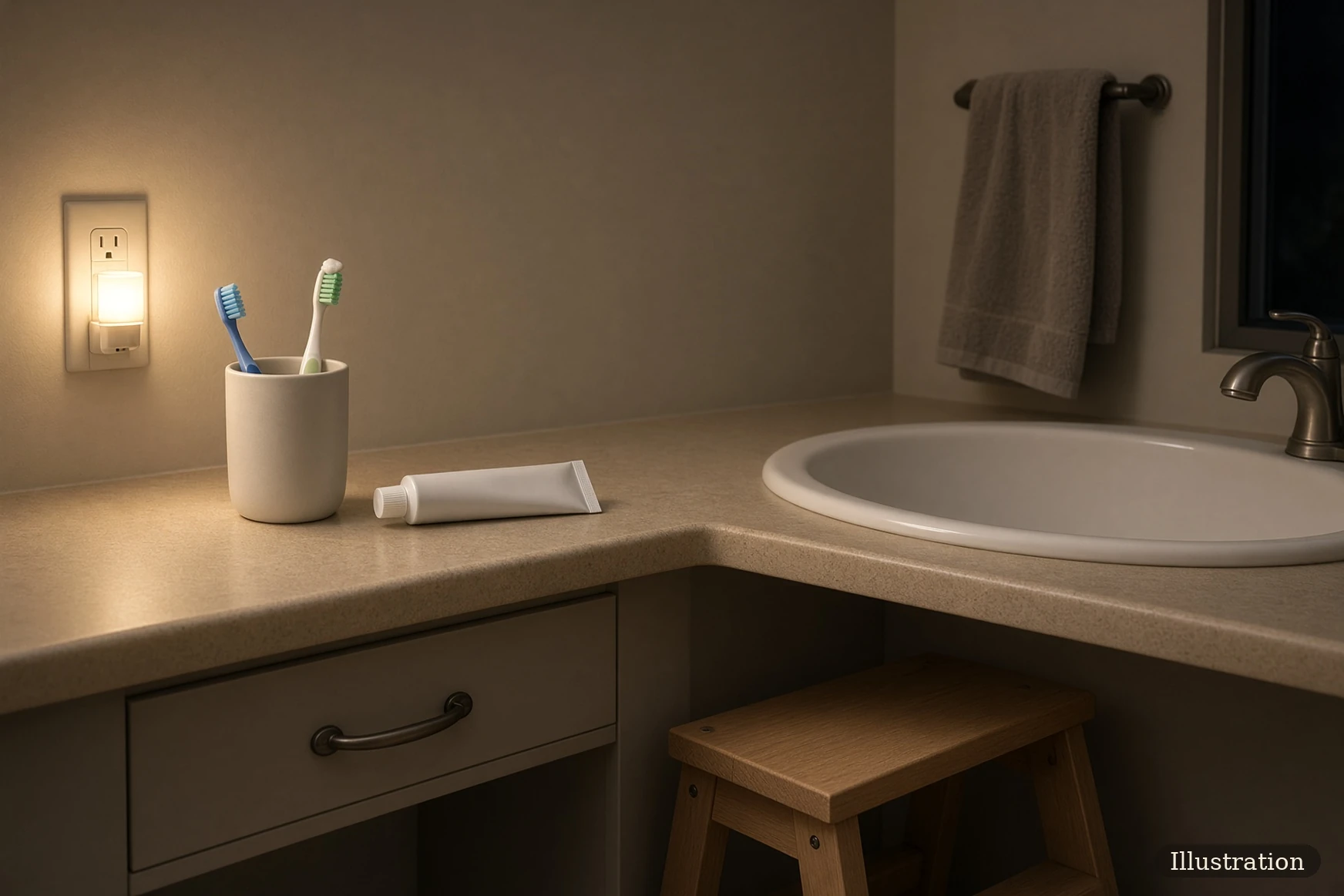
Brushing. From the first tooth, brush twice a day with fluoride toothpaste: a smear the size of a grain of rice until age 3, then a pea-sized amount. Brush for them until they can do it well, which is later than they'll want you to.
Fluoride varnish. Your pediatrician or dentist may paint fluoride varnish on your child's teeth. The AAP recommends it 2 to 4 times a year until age 5. It takes a minute and doesn't hurt.
If your child has Medicaid, Texas Health Steps covers free dental checkups starting at 6 months old, along with regular medical checkups from birth through age 20. For children 6 to 35 months, Texas's First Dental Home program adds a package of care: a risk check, cleaning, fluoride varnish and advice for you. The Texas Health Steps page at HHS explains how to find a provider, and case managers can help you connect with medical, dental and other services.
Your pediatrician checks your baby's eyes from the first days, looking at how the eyes reflect light and, from about 6 months, at whether they move together. Vision screening with a photo device can start at 1 to 2 years. Chart-reading screening is recommended at ages 4 and 5, and at 3 if your child will cooperate.
At school, Texas requires vision and hearing screening for children entering school for the first time (including 4-year-olds in pre-K), for kindergartners, and in grades 1, 3, 5 and 7, within 120 calendar days of the first day of attendance. The state's screening schedule applies to licensed child care and Head Start too, for children who are 4 by September 1 and any first-time entrant from age 4 through 12th grade. Private schools and child care can accept proof of a screening done somewhere else, such as at your doctor's. If a note comes home, don't let it sit in the backpack. Children don't outgrow a lazy eye, and the earlier it's treated, the better it works. CHIP covers vision and hearing care, and so does Medicaid through Texas Health Steps; ask about glasses when you call.
Your baby's hearing was checked in the hospital. The CDC's goal is a screen by 1 month, a full test by 3 months if the screen raised a question, and help started by 6 months if there is hearing loss. If your newborn was asked to come back for another hearing test, go. A hearing loss found at 3 months is a very different story from one found at 3 years.
After that, the CDC's advice to parents is simple: if you suspect your child has trouble hearing, trust your instincts and tell the doctor. You know how your child responds to your voice better than any test does.
If your child is in licensed child care or Head Start, the same vision and hearing schedule applies from age 4, so a first screening can happen a year before kindergarten, and the note that comes home deserves the same follow-up. Texas also screens spines for curvature: girls at age 10 and 12 (grades 5 and 7), boys at 13 or 14 (grade 8).
For teeth, Children's Dentistry Of Baytown, at 4001 Garth Road, lists Monday to Thursday hours of 8 a.m. to 5 p.m. and is a pediatric dental practice, which means it sees children as its work rather than as an add-on. In Crosby, Action Dental + Kids, at 105 Kennings Road, Suite 2, is listed as a pediatric dentist. Ask either when the first visit should be and what the office does for a child who is afraid.
For eyes, Memorial Eye Center - Baytown, at 6956 Garth Road, lists weekday hours of 8:30 a.m. to 5:30 p.m. and Saturday morning to 3. In Mont Belvieu, Eagle Family Vision, at 3650 Eagle Creek Drive, lists comprehensive eye exams with Monday to Thursday hours from 7 a.m. and a Friday morning schedule. Call first and ask whether the office examines young children and from what age, since not every optometrist does.
For ears and speech, Adobe Speech & Hearing Systems, at 2500 Market Street, is listed with weekday hours from 11 a.m. and Saturday until 2 p.m. Start with your pediatrician if you have a concern about hearing, and see Is my child on track? for how speech and hearing fit into the developmental checklist.
American Academy of Pediatric Dentistry, parent FAQ; AAP HealthyChildren.org, "FAQ: Fluoride and Children" and "Vision Screenings"; Texas HHS, Texas Health Steps and First Dental Home; Texas HHS, CHIP benefits; Texas DSHS, Vision, Hearing and Spinal Screening Program schedule and FAQs; CDC, hearing loss in children, screening; practice listings as shown on each place card.
Un niño no sabe decirle que ve borroso o que le duele un diente; estas revisiones sirven para enterarse. Dientes: la primera visita cuando sale el primer diente o antes del primer cumpleaños. Cepille dos veces al día con pasta con flúor: un grano de arroz hasta los 3 años, luego del tamaño de un chícharo. Con Medicaid, Texas Health Steps cubre revisiones dentales gratis desde los 6 meses; la página de HHS explica cómo encontrar dentista. Ojos: la prueba con tabla se recomienda a los 4 y 5 años. En Texas, las escuelas revisan la vista y el oído al entrar por primera vez y en 1.º, 3.º, 5.º y 7.º grado; si llega una nota a casa, no la deje en la mochila. En Baytown: Children's Dentistry Of Baytown y Adobe Speech & Hearing Systems.
| Mon | 8 AM – 5 PM |
|---|---|
| Tue | 8 AM – 5 PM |
| Wed | 8 AM – 5 PM |
| Thu | 8 AM – 5 PM |
| Fri | Closed |
| Sat | Closed |
| Sun | Closed |
| Mon | 10 AM – 5 PM |
|---|---|
| Tue | Closed |
| Wed | 10 AM – 5 PM |
| Thu | 9 AM – 5 PM |
| Fri | 9 AM – 3 PM |
| Sat | 10 AM – 2 PM |
| Sun | Closed |
| Mon | 8:30 AM – 5:30 PM |
|---|---|
| Tue | 8:30 AM – 5:30 PM |
| Wed | 8:30 AM – 5:30 PM |
| Thu | 8:30 AM – 5:30 PM |
| Fri | 8:30 AM – 5:30 PM |
| Sat | Closed |
| Sun | Closed |
| Mon | 7 AM – 4:30 PM |
|---|---|
| Tue | 7 AM – 4:30 PM |
| Wed | 7 AM – 4:30 PM |
| Thu | 7 AM – 4:30 PM |
| Fri | 7 AM – 12 PM |
| Sat | Closed |
| Sun | Closed |
 Illustration
| Mon | 11 AM – 7 PM |
|---|---|
| Tue | 11 AM – 7 PM |
| Wed | 11 AM – 7 PM |
| Thu | 11 AM – 7 PM |
| Fri | 11 AM – 5 PM |
| Sat | 11 AM – 2 PM |
| Sun | Closed |
Ours to fix
We read every one, and we write back when it's fixed.