Texas Department of Public Safety
Hours
| Mon | 8 AM – 5 PM |
|---|---|
| Tue | 8 AM – 6 PM |
| Wed | 8 AM – 5 PM |
| Thu | 8 AM – 5 PM |
| Fri | 8 AM – 5 PM |
| Sat | Closed |
| Sun | Closed |
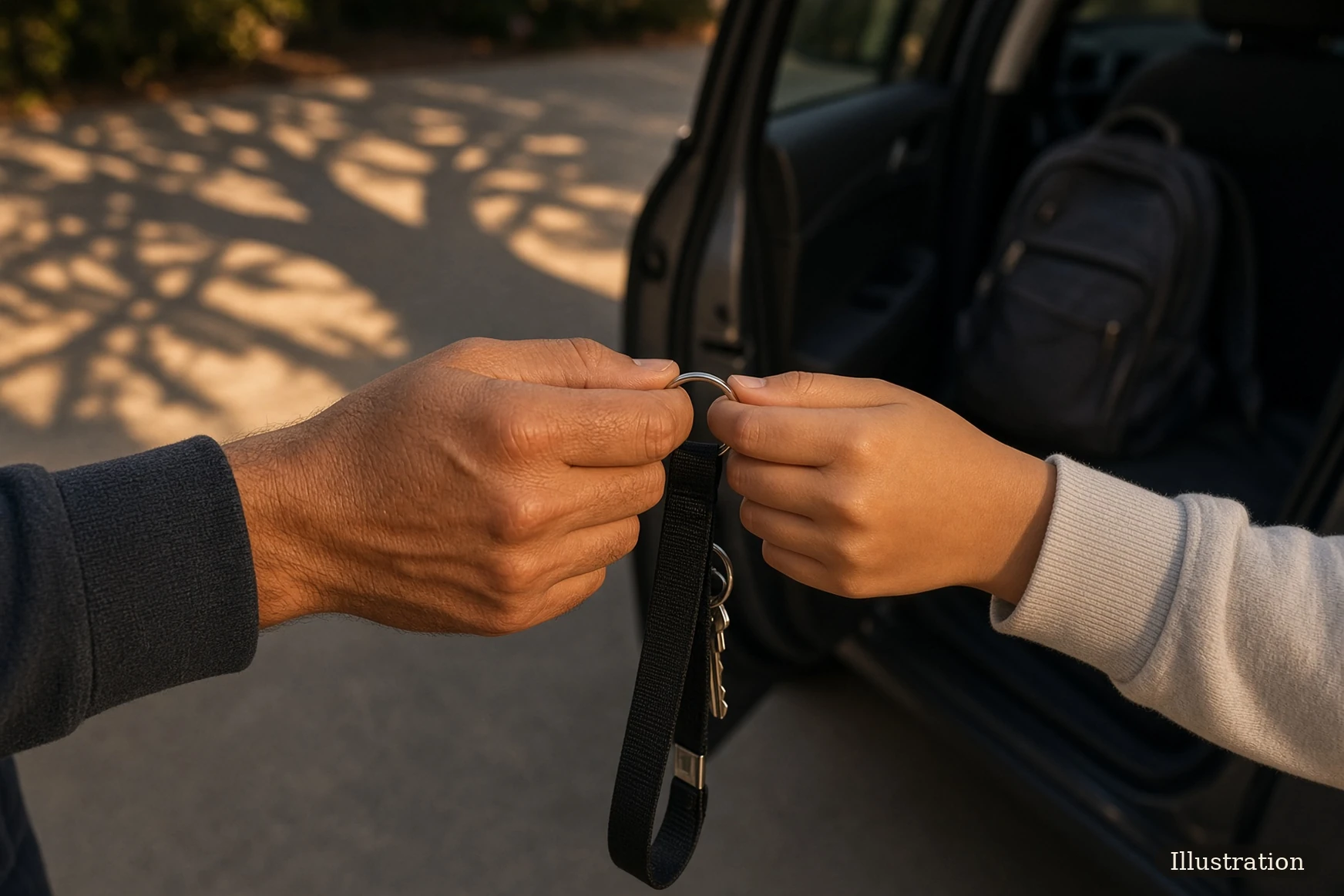 Illustration
Teenagers need more independence without losing the safety of a parent who is still paying attention. Keep the relationship open while they practice driving, work, privacy, money, relationships and decisions that increasingly belong to them.
Somewhere around thirteen, the child who used to hold your hand in the parking lot starts walking three steps ahead of you. It's supposed to happen. The whole long project of raising a person has been heading for this: someone who can drive the car, earn a paycheck, make their own call and come home anyway. Your job changes from keeping them safe to teaching them to keep themselves safe, which is harder and matters more.
They still need you, more than they'll say. Keep eating dinner together when you can. Keep driving them places, because the car is where teenagers talk, sitting side by side with nobody having to look at anybody. And keep the door open, especially on the nights they come home having done something foolish.
Connection at sixteen does not look like connection at six.
The important conversation may arrive in the car because eye contact is too much, at 11:40 p.m. when you wanted to sleep, or in three sentences while the refrigerator door is open.
CDC guidance on parental monitoring is less about spying than staying involved: know where your teenager is and who they are with, set clear expectations, check in, know their friends, and keep talking. Those practices are associated with lower rates of several health and safety risks.
Adolescence also needs room for practice.
They need some privacy. They need low-stakes decisions they can get wrong. They need to learn how to call an office, handle money, apologize, end a friendship, refuse a ride, ask for help and come home after being wrong.
The closed bedroom door does not mean the relationship is over.
It means the relationship has a door now.
Knock.
The American Academy of Pediatrics describes confidentiality as an important part of high-quality adolescent healthcare and recommends giving adolescents developmentally appropriate time alone with their clinician, within legal and safety limits.
That can surprise a parent the first time.
It is not the pediatrician replacing you.
It is part of teaching a young person to become the adult who will eventually manage their own medicines, questions, appointments and body.
Good adolescent care also encourages teenagers to involve parents or another trusted adult when appropriate. Privacy and family connection do not have to be enemies.
Do not save one enormous conversation for the day you think they are ready.
AAP parent guidance recommends ongoing, smaller conversations about relationships, sex, pressure, boundaries, consent and online safety.
A teenager should know that: - consent means an actual yes, not the absence of a no; - pressure is not affection; - consent can be withdrawn; - alcohol or drugs can make meaningful consent impossible; - intimate images and messages can survive the relationship that produced them; - they can bring you a problem without automatically making the problem worse.
You do not have to make these conversations elegant.
You do have to make them possible.
Texas licenses teenagers in steps: - Learner license at 15, after driver education classroom instruction (6 hours in the concurrent format or 24 in the block format, depending on the course) through a driving school, a public school course, or the parent-taught program. - Hold the learner license at least six months. A licensed adult 21 or older has to sit in the front passenger seat, and all cell phone use is prohibited, even hands-free. DPS gives you a temporary permit right away, and the card comes in the mail in two to three weeks. - Provisional license at 16 to 17, after 14 hours of behind-the-wheel instruction (7 observing and 7 driving), 30 hours of practice driving with at least 10 at night, and the free Impact Texas Teen Drivers program within 90 days of the driving test. The rules: no more than one passenger under 21 who isn't family, no driving between midnight and 5 a.m. except for work, school activities or an emergency, and no phone at all while driving, not even hands-free.
The rules exist because the first year is the riskiest. Plenty of families add rules of their own. Write them down together, sign it, and put it on the fridge. Texas DPS teen licenses.
In Baytown, the Texas Department of Public Safety driver license office is at 5420 Decker Drive, open weekdays 8 a.m. to 5 p.m. and until 6 on Tuesday. Baytown Driving School, at 605 Massey Tompkins Road, and Island Driving School - Baytown, at 407 W. Baker Road, Suite F, are two local driving schools we list; ask whether the course meets the Texas requirement before you pay.
On the water. Anyone born on or after September 1, 1993 must take a boater education course before running a motorboat over 15 horsepower, a sailboat over 14 feet, or any personal watercraft on their own. The minimum age to operate them is 13. TPWD boater education.
A first paycheck teaches things school can't: showing up on time, a boss who isn't your mother, what's left after taxes. In Texas most jobs start at 14. For 14- and 15-year-olds, federal law sets the stricter limits during the school year: no more than 3 hours on a school day or 18 hours in a school week, and only between 7 a.m. and 7 p.m. (9 p.m. from June 1 to Labor Day). Summer allows up to 8 hours a day and 40 a week. At 16 most of these limits end. Texas Workforce Commission, child labor law.
Lee College, right here in Baytown, has partnered with local high schools so students can earn college credit before graduation, through dual credit classes and an early college high school with Goose Creek CISD. Lee's site describes traditional dual credit, for up to 42 semester credit hours, and early college high school, for up to 60 semester credit hours toward a degree, at a discounted tuition rate. IMPACT Early College High School, at 1415 Market Street, is the Goose Creek CISD campus built for that route, and the state rated it A (96) for 2026. Ask your high school counselor what's offered this year and what it costs, and see Lee College for families.
A phone can be a map, school portal, camera, friend group, workplace, diary, source of comparison and place to hide.
The useful family question is not only how many minutes?
Ask what the phone is displacing: - sleep; - homework; - movement; - in-person friendship; - family time; - or, sometimes, nothing important in that moment.
Parents have to model this too, which is inconvenient. It is difficult to explain that dinner should be screen-free while answering work email under the table.
The goal is not a teenager who never looks at a screen.
It is a person who can eventually notice when the screen has begun choosing for them.
The teenage years can be heavy: the sleep that never comes, the phone that never stops, the friendships that turn overnight. Most teenagers come through fine. Some need more help than a parent can give alone, and that isn't a failure on anyone's part.
Watch for the changes that last: pulling away from everything they used to enjoy, sleeping all the time or not at all, grades falling off a cliff, talk of being a burden. Ask them directly how they're doing. Asking about suicide won't put the idea in their head. - 988: call or text, or chat at 988lifeline.org, free, 24/7, for them or for you. - The Harris Center for Mental Health and IDD, Harris County's local mental health authority: it runs a 24/7 crisis and access line, and the number is on theharriscenter.org. It also lists behavioral health services for children. - Your pediatrician, who still sees teenagers and will talk with them privately.
Sterling Municipal Library takes teen volunteers, and its calendar lists programs for teens, so check the calendar. It is open until 8 p.m. Monday to Thursday, and closed Sunday. A teenager with somewhere to be and something to do is a teenager with fewer hours to fill in worse ways.
Texas DPS, learner license, provisional license, and graduated driver license pages; Texas Parks and Wildlife, boater education FAQ; Texas Workforce Commission, Texas Child Labor Law; Lee College, dual credit; Goose Creek CISD and Texas Education Agency 2026 accountability ratings; 988 Suicide & Crisis Lifeline; The Harris Center for Mental Health and IDD; Sterling Municipal Library; CDC, Parental Monitoring and adolescent connectedness resources; American Academy of Pediatrics, "Confidentiality in the Care of Adolescents" (2024 policy statement) and current HealthyChildren guidance on teen sexual health, relationships and consent.
Alrededor de los trece, el niño que le daba la mano empieza a caminar tres pasos adelante. Siguen necesitándolo: cenen juntos y deje la puerta abierta. Manejar en Texas: permiso de aprendiz a los 15; tenerlo al menos seis meses; licencia provisional a los 16–17 tras 14 horas de instrucción, 30 horas de práctica y el programa Impact Texas Teen Drivers. No más de un pasajero menor de 21 que no sea familia, no manejar de medianoche a las 5 a.m. y nada de teléfono. Trabajo: desde los 14; máximo 3 horas en día escolar. Lee College ofrece créditos universitarios en la preparatoria. La Academia Americana de Pediatría recomienda que los adolescentes tengan tiempo a solas con su profesional de salud. Si su hijo está pasando por un mal momento, pregúntele directamente; llame o mande texto al 988.
| Mon | 8 AM – 5 PM |
|---|---|
| Tue | 8 AM – 6 PM |
| Wed | 8 AM – 5 PM |
| Thu | 8 AM – 5 PM |
| Fri | 8 AM – 5 PM |
| Sat | Closed |
| Sun | Closed |
| Mon | 11 AM – 6 PM |
|---|---|
| Tue | 11 AM – 6 PM |
| Wed | 11 AM – 6 PM |
| Thu | 11 AM – 6 PM |
| Fri | 11 AM – 5 PM |
| Sat | 9 AM – 3 PM |
| Sun | Closed |
| Mon | 1 PM – 6 PM |
|---|---|
| Tue | 1 PM – 6 PM |
| Wed | 1 PM – 6 PM |
| Thu | 1 PM – 6 PM |
| Fri | 12 PM – 5:30 PM |
| Sat | Closed |
| Sun | Closed |
| Mon | 8 AM – 3:30 PM |
|---|---|
| Tue | 8 AM – 3:30 PM |
| Wed | 8 AM – 3:30 PM |
| Thu | 8 AM – 3:30 PM |
| Fri | 8 AM – 3:30 PM |
| Sat | Closed |
| Sun | Closed |
 Illustration
| Mon | 10 AM – 8 PM |
|---|---|
| Tue | 10 AM – 8 PM |
| Wed | 10 AM – 8 PM |
| Thu | 10 AM – 8 PM |
| Fri | 10 AM – 5 PM |
| Sat | 10 AM – 5 PM |
| Sun | Closed |
Ours to fix
We read every one, and we write back when it's fixed.