Baytown Nature Center
6213 Bayway Dr, Baytown
(281) 424-9198
Open daily year-round except Christmas, Thanksgiving, and extreme inclement weather; gates open 30 minutes before sunrise and close 30 minutes after sunset
 Illustration
Children need organized activities, but they also need time that belongs to them. Baytown gives families plenty of material for both: fields, parks, water, mud, libraries, trails and ordinary afternoons without a lesson plan.
Play is easy to praise after adults have made it educational.
STEM play. Sensory play. Language-building play. Motor-skills play.
Those descriptions can all be true.
The American Academy of Pediatrics says play supports children's social-emotional, cognitive, language and self-regulation skills.
But a child does not need to know the developmental objective.
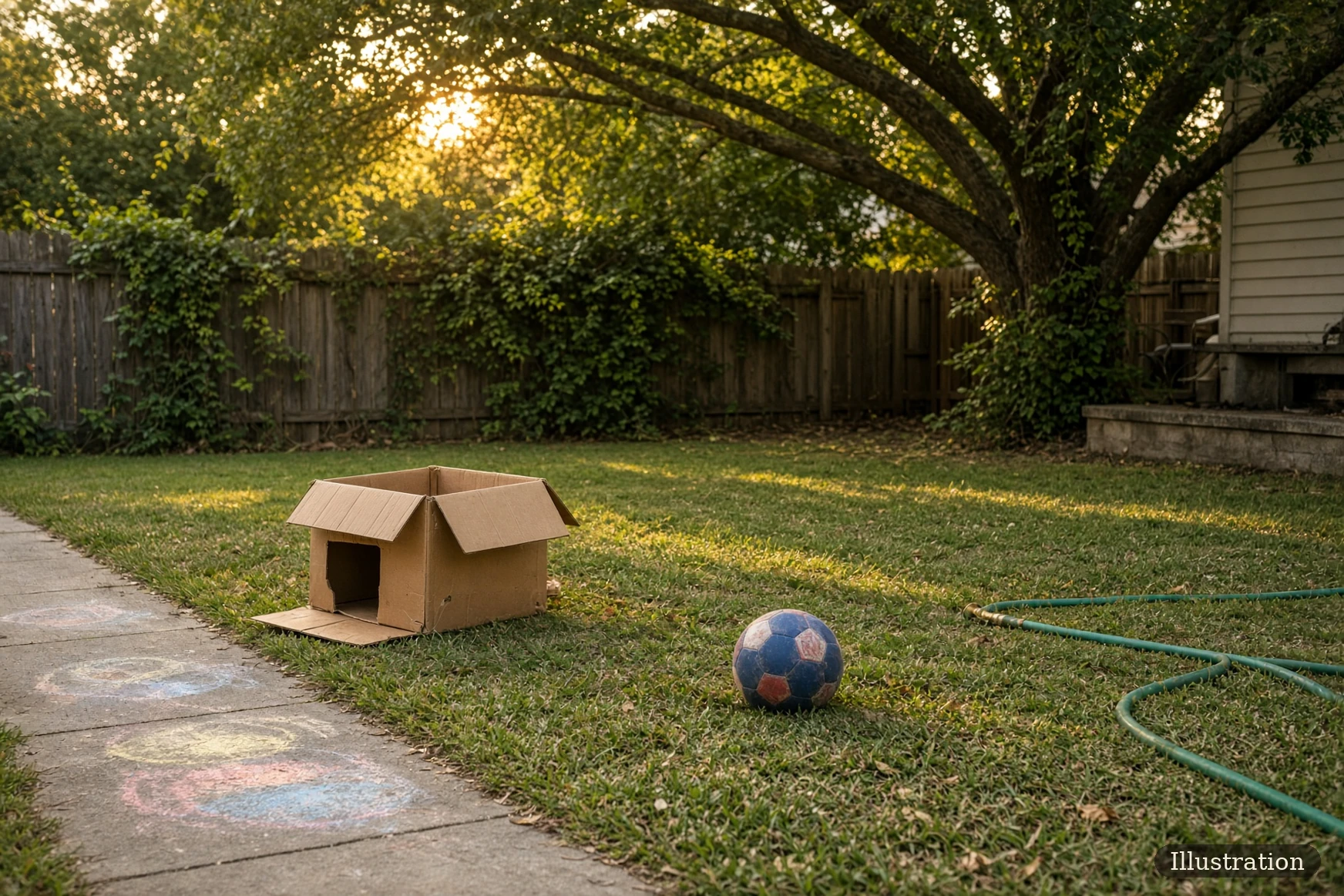
They may simply need the hose.
The cardboard box.
The stick that is temporarily a sword, then a fishing rod, then a tool adults are not allowed to understand.
Sports and classes can be wonderful.
Children learn skill, routine, teamwork, how to listen to another adult, how to lose and how to improve.
Unstructured play asks a different question:
What will you do when nobody tells you what to do?
Sometimes the answer is "I'm bored."
Parents can hear that sentence as an emergency.
It is not always one.
A child may need a few empty minutes before imagination arrives.
That does not mean every family has endless free time, a safe yard or a parent available all afternoon. Unstructured play should not become one more thing parents are told they are failing to provide.
It means that when the family has room, not every empty space needs to be filled.
Public-health guidance recommends that children be physically active throughout childhood. For school-age children and teenagers, the federal/CDC target is at least 60 minutes of physical activity each day; younger children should be active across the day.
That does not mean every child needs to play competitive sports.
Walking counts toward an active life.
Climbing counts.
Swimming counts.
Dancing badly counts.
Playing tag counts.
A child can dislike teams and still need movement.
The CDC's guidance for ages 3 to 5 is simply to be active throughout the day, and the example it gives is play: jumping, riding a tricycle. For ages 6 to 17 it asks for 60 minutes or more of moderate-to-vigorous activity a day, mostly the heart-pumping kind, with muscle-strengthening like climbing and bone-strengthening like jumping and running on at least three days a week. It also says a child may already be getting there through ordinary play and school activity, without anyone signing them up for anything.
If your child wants organized activities, see Sports, dance and activities. If they do not, that is not a developmental emergency.
Baytown has water, parks, the Nature Center, splash pads, the library, fields and ordinary neighborhoods where an afternoon can still happen.
See Things to do with kids for the full list. Here are the ones that work best for an unplanned afternoon.
The Baytown Nature Center, at 6213 Bayway Drive, is open every day of the year except Thanksgiving and Christmas, with the gates opening 30 minutes before sunrise and closing 30 minutes after sunset. The city's listing shows a small fee, about $4 for adults and $1 for children 5 to 12, so a family of four gets an afternoon of sky for the price of a fast-food drink. There is nothing to do there that anyone planned for you, which is the point.
The Eddie V. Gray Wetlands Center, at 1724 Market Street, is free, open Monday to Friday 8 a.m. to 4 p.m. and Saturday 10 to 4, and closed Sunday. The listing mentions baby alligators and a working hive. The Goose Creek Trail starts from the same parking lot and runs about 5.7 miles through woods and along piers, and the trail stays open on Sundays when the center is closed.
The neighborhood parks are free, open from 5 a.m. to 10 p.m. by the city's listing, and closer than you think. Central Heights Park, at 503 Atlantic, and Bergeron Park, at 1520 Louisiana, both have a playground, a pavilion and a splash pad, and Bergeron has lights for the long summer evenings.
On the days that are too hot, too wet or too much, Olivia’s Playhouse, at 6909 Garth Road, is an indoor playground open daily, 10 a.m. to 7 p.m. most days with a later Saturday and a shorter Sunday on the hours we hold. Its site asks you to sign a liability waiver in advance, and it lists a monthly membership for families who go often.
A ferry ride can be transportation to an adult and enormous machinery to a child.
A stick by the trail can be more interesting than the interpretive sign.
Not every outing needs a learning objective.
Some can simply become part of childhood.
Children should learn that commitments matter.
So should parents.
Finishing a season after signing up can be a reasonable family rule.
Signing up for the same thing forever is not.
A seven-year-old may dislike soccer because the socks itch, the coach is loud, everyone else seems faster, or because the child simply discovered that soccer is not for them.
Childhood is partly for trying identities on: soccer player, swimmer, dancer, theater kid, reader, kid who spends three months obsessed with rocks.
A child who quits one activity has not necessarily learned to quit life.
Sometimes they learned something accurate about themselves.
Sometimes the best parent participation is active.
Throw the ball. Get in the water. Build the thing.
Sometimes the better role is sitting nearby.
Not correcting the game.
Not asking whether this will become a talent.
Just being the place the child can look toward and find someone still there.
American Academy of Pediatrics / HealthyChildren.org, "Power of Play"; CDC, physical activity guidance for children and adolescents (cdc.gov/physical-activity-basics); CDC, heat and infants and children; City of Baytown, Baytown Nature Center and park listings; Olivia’s Playhouse, website.
Jugar no es tiempo perdido. La Academia Americana de Pediatría explica que el juego ayuda al desarrollo social y emocional, al lenguaje, al pensamiento y al autocontrol. Los deportes pueden ser excelentes, y también lo es el juego sin un adulto dirigiendo cada minuto. A veces "estoy aburrido" es el paso antes de inventar algo. Los CDC recomiendan que los niños de 3 a 5 años se muevan durante el día, y que los de 6 a 17 hagan 60 minutos o más de actividad al día; caminar, nadar, bailar y jugar cuentan. Si un niño prueba fútbol y no le gusta, eso también es información. En Baytown hay dónde jugar sin gastar: el Baytown Nature Center, el Eddie V. Gray Wetlands Center (gratis, cerrado los domingos), los parques del vecindario y Olivia’s Playhouse, un parque de juegos bajo techo.
| Mon | 8 AM – 4 PM |
|---|---|
| Tue | 8 AM – 4 PM |
| Wed | 8 AM – 4 PM |
| Thu | 8 AM – 4 PM |
| Fri | 8 AM – 4 PM |
| Sat | 10 AM – 4 PM |
| Sun | Closed |
| Mon | 5 AM – 10 PM |
|---|---|
| Tue | 5 AM – 10 PM |
| Wed | 5 AM – 10 PM |
| Thu | 5 AM – 10 PM |
| Fri | 5 AM – 10 PM |
| Sat | 5 AM – 10 PM |
| Sun | 5 AM – 10 PM |
| Mon | 5 AM – 10 PM |
|---|---|
| Tue | 5 AM – 10 PM |
| Wed | 5 AM – 10 PM |
| Thu | 5 AM – 10 PM |
| Fri | 5 AM – 10 PM |
| Sat | 5 AM – 10 PM |
| Sun | 5 AM – 10 PM |
 Illustration
| Mon | 10 AM – 7 PM |
|---|---|
| Tue | 10 AM – 7 PM |
| Wed | 10 AM – 7 PM |
| Thu | 10 AM – 7 PM |
| Fri | 10 AM – 7 PM |
| Sat | 10 AM – 8 PM |
| Sun | 10 AM – 6 PM |
Ours to fix
We read every one, and we write back when it's fixed.