Keeping them safe
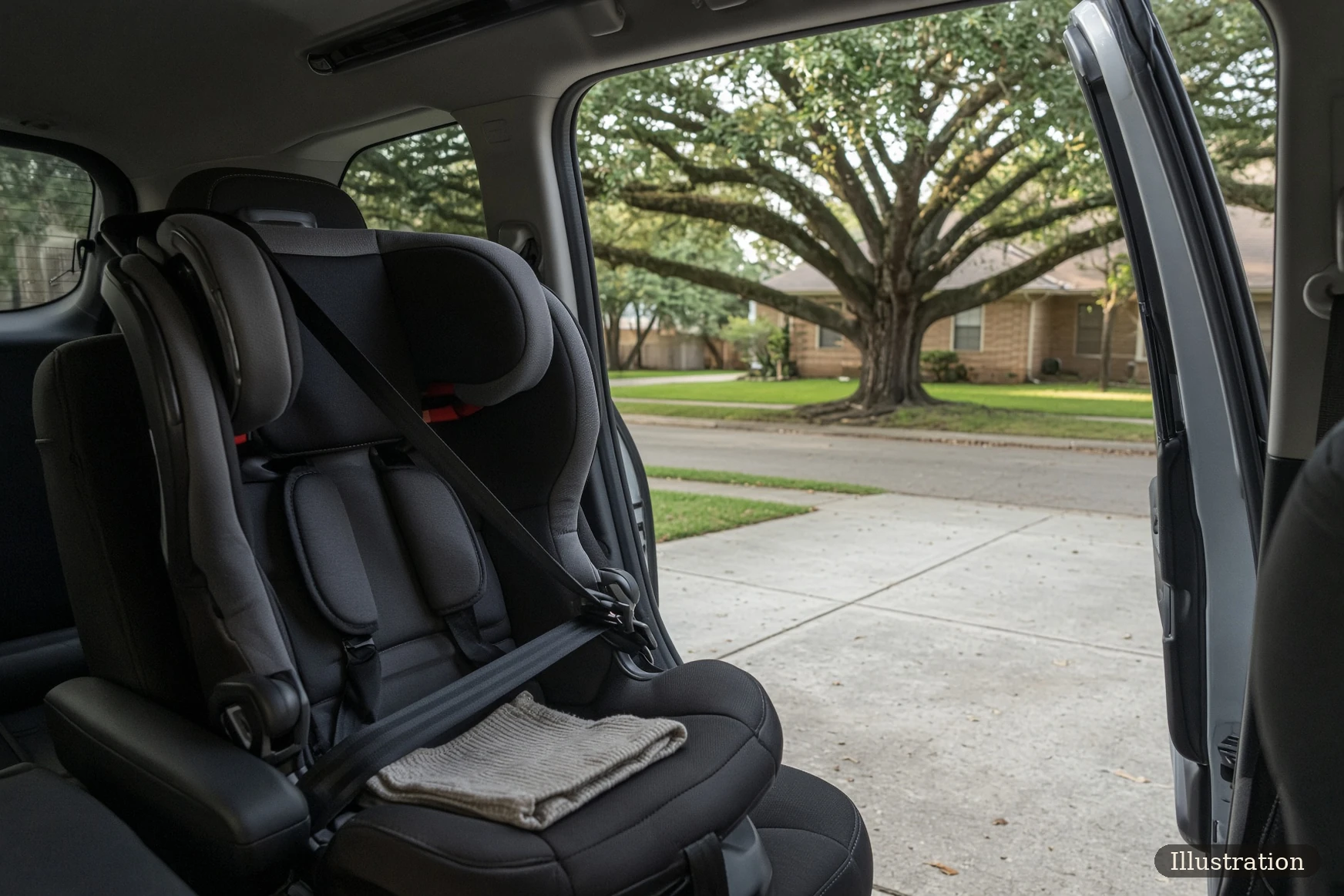 Illustration
The biggest child-safety risks are usually ordinary: cars, water, heat, sleep, medicines and firearms. Build the protections into daily routines so safety does not depend on remembering everything in a rushed moment.
Build safety into the routine
- Check the car seat fit after growth spurts.
- Never leave a child alone in a vehicle.
- Assign one adult to watch children around water.
- Use life jackets when the activity requires them.
- Make the sleep space simple and clear.
- Lock medicines and cleaning products.
- Store firearms locked and inaccessible to children.
- Keep Poison Control where every caregiver can find it.
- Teach older children the same household rules.
- Recheck the house when a child learns a new skill.
- Do not rely on a child remembering a rule near water.
- Treat heat as a planning issue, not a toughness test.
The fuller answer
Most of what hurts small children isn't exotic. It happens in the car, in the water, in the heat, in the crib and in the cabinet under the sink, the ordinary places of an ordinary day. That's hard to hear, but there's hope in it too. Because the dangers are ordinary, so are the protections: a buckle done right, a gate latched, a glance in the back seat.
Baytown has water on almost every side, with the bay to the south, the San Jacinto and the ship channel to the west, and Cedar Bayou to the east. The summers are long and hot. Those two facts shape a lot of this page. Here is what the people who study it say, and where in and around Baytown to get help.
In the car
Texas law (Transportation Code §545.412) requires a child younger than 8 to ride in a car seat or booster seat unless the child is taller than 4 feet 9 inches. A fine runs from $25 to $250.
The law is the minimum. The National Highway Traffic Safety Administration describes four stages, and the advice is to keep a child in each stage as long as the seat's height and weight limits allow: 1. Rear-facing car seat, from birth — as long as possible. 2. Forward-facing car seat with a harness, once they outgrow rear-facing. 3. Booster seat, until the seat belt fits: the lap belt across the upper thighs, the shoulder belt across the chest, not the neck. 4. Seat belt — and the back seat until 13.
Free car seat checks. TxDOT's Save Me With A Seat program lets you find a car seat inspection near you by zip code, and Safe Kids Worldwide keeps a locator of certified technicians. A trained tech will show you how to install your own seat — most parents who check find something to fix.
Texas Children's Hospital runs free car seat checks by appointment at partner sites around the Houston area, and its page says each takes about 30 minutes and works best if you bring your child so the tech can fit the seat to them. The nearest partner sites it lists to Baytown are the Channelview Fire Department on Dell Dale and the Little York Fire Department. The City of Baytown also lists a Child Safety Seat Check page on its site, at baytown.org, worth a look for local dates. Book before the baby comes, since every site requires an appointment.
Around water
The CDC says more children ages 1 to 4 die from drowning than from any other cause, and for ages 5 to 14 it is the second leading cause of unintentional injury death after car crashes. It is fast and it is quiet. The protection is layers: an adult watching the water and only the water, a fence around a home pool, swim lessons, and life jackets. The CDC also points out that drowning is not always fatal, which is one more reason the adult at the water should be the one who isn't looking at a phone.
Swim lessons are the layer most families skip. Sports, dance and activities lists the swim schools that teach lessons. Our swimming and water questions page has more on local water.
On a boat in Texas, Texas Parks and Wildlife requires children under 13 to wear a life jacket whenever the boat is underway. On Galveston Bay, on Cedar Bayou, at the lake — every time.
In a hot car
NHTSA counts about 37 children a year dying in hot cars across the country, and more than half of them are under 2. Texas DSHS says Texas is one of the states with the highest numbers. On a Baytown summer day a closed car gets dangerous fast, even with the windows cracked.
The parents this happens to are not careless people. It often happens on a day when the routine changed: a different parent doing daycare drop-off, an early meeting, a baby who fell asleep and went quiet. Don't count on remembering. Build a habit that works even on the day your memory doesn't. - Look before you lock. Every time. - Put something you need — your phone, your bag, your badge — in the back seat. - Keep the car locked at home and the keys out of reach; children climb in on their own. - If you see a child alone in a hot car, call 911.
Texas law also makes it an offense to leave a child younger than 7 alone in a vehicle for more than five minutes, unless someone 14 or older is with them.
Safe sleep
The first place most parents hear this is the pediatrician, and Texas Children's Pediatrics Baytown at 7599 Garth Road, Suite 600, is one of the offices where you can ask, on weekdays 8 a.m. to 5 p.m. on the hours we hold. The American Academy of Pediatrics' advice for babies is simple to say: alone, on their back, in a crib — a firm, flat mattress with a fitted sheet, and nothing else in it: no pillows, bumpers, blankets or stuffed animals. Room-sharing without bed-sharing. Don't let a baby sleep on a couch or in an armchair, and don't use a seat or swing for routine sleep.
Under the sink
Lock up medicines, cleaning products, laundry pods and button batteries, and keep them in their original containers. Save Poison Control, 1-800-222-1222, in your phone today. If something happens tonight, see Call, urgent care, or the ER. If Poison Control tells you to go in, Baytown's hospital emergency department is the Houston Methodist Baytown Hospital Emergency Department at 4401 Garth Road, which is open around the clock.
If there is a gun in the home
The American Academy of Pediatrics says the safest home for children is one without a firearm. If a gun is present, current AAP guidance is to store it locked and unloaded, with ammunition locked separately, and to keep keys or combinations where children and teenagers cannot get them.
This is also a reasonable question before a playdate: Is there an unlocked gun in the home?
It can feel awkward the first time you ask. The point is not to judge another family. It is to know what environment your child is entering. A safety plan that works only if a child is never curious is not enough by itself.
Before you go
- Book a car seat check before your due date, and bring the seat's manual and your child.
- Put Poison Control in your phone today, and check that every adult who watches your child has it too.
- Look in the back seat every time you park, and put something you need there so that looking becomes automatic.
- Sign your child up for swim lessons before the summer rush, and ask the program about life jackets for the bay and the bayou.
- Ask about locked medicines and an unsecured gun before a playdate at someone else's house.
Sources
Texas Transportation Code §545.412; NHTSA, "Car Seats and Booster Seats" and "Heatstroke"; TxDOT, Save Me With A Seat; Safe Kids Worldwide; Texas Children's Hospital, Injury Prevention car seat checks; CDC, "Drowning Facts"; Texas Parks and Wildlife, boating life jacket rules; Texas DSHS, hot-car safety; Texas Penal Code §22.10; AAP HealthyChildren.org, safe sleep and "Guns in the Home: How to Keep Kids Safe"; Poison Control (poison.org).
En español
Casi todo lo que lastima a los niños pequeños pasa en lugares de todos los días, y por eso las protecciones también son sencillas. En Texas, todo niño menor de 8 años debe ir en asiento de seguridad o elevador, a menos que mida más de 4 pies 9 pulgadas. TxDOT, Safe Kids y Texas Children's Hospital revisan su asiento gratis, con cita. El ahogamiento causa más muertes de niños de 1 a 4 años que cualquier otra cosa: un adulto mirando solo el agua, cerca alrededor de la piscina, clases de natación y chalecos salvavidas. Autos calientes: mire antes de cerrar y, si ve a un niño solo en un auto caliente, llame al 911. Si hay un arma en la casa, guárdela descargada y bajo llave. Control de envenenamiento: 1-800-222-1222.
Places named on this page(2)
Texas Children's Pediatrics Baytown
Hours
| Mon | 8 AM – 5 PM |
|---|---|
| Tue | 8 AM – 5 PM |
| Wed | 8 AM – 5 PM |
| Thu | 8 AM – 5 PM |
| Fri | 8 AM – 5 PM |
| Sat | Closed |
| Sun | Closed |