Late May, and the town runs out of folding chairs. Three high schools graduate in the same stretch of days: Sterling, Lee, and Goose Creek Memorial, the three in Goose Creek CISD, plus Barbers Hill up the road in Mont Belvieu and Lee College over on its own calendar. For a week and a half every gymnasium and stadium and church hall with air conditioning is full of families in their good clothes, fanning themselves with the program, standing up too early to take a picture. Somebody's grandmother has been holding the same spot on the bleachers since noon. Somebody's little brother has already dropped the balloon.
It is a lot of ceremony for a town that does not go in for ceremony, and it is right that it should be. The town does not have many days when it stops and looks at itself. This is one.
The ceremony is a door, though, and in this town the door is often a gate, with a hard hat waiting on the other side.
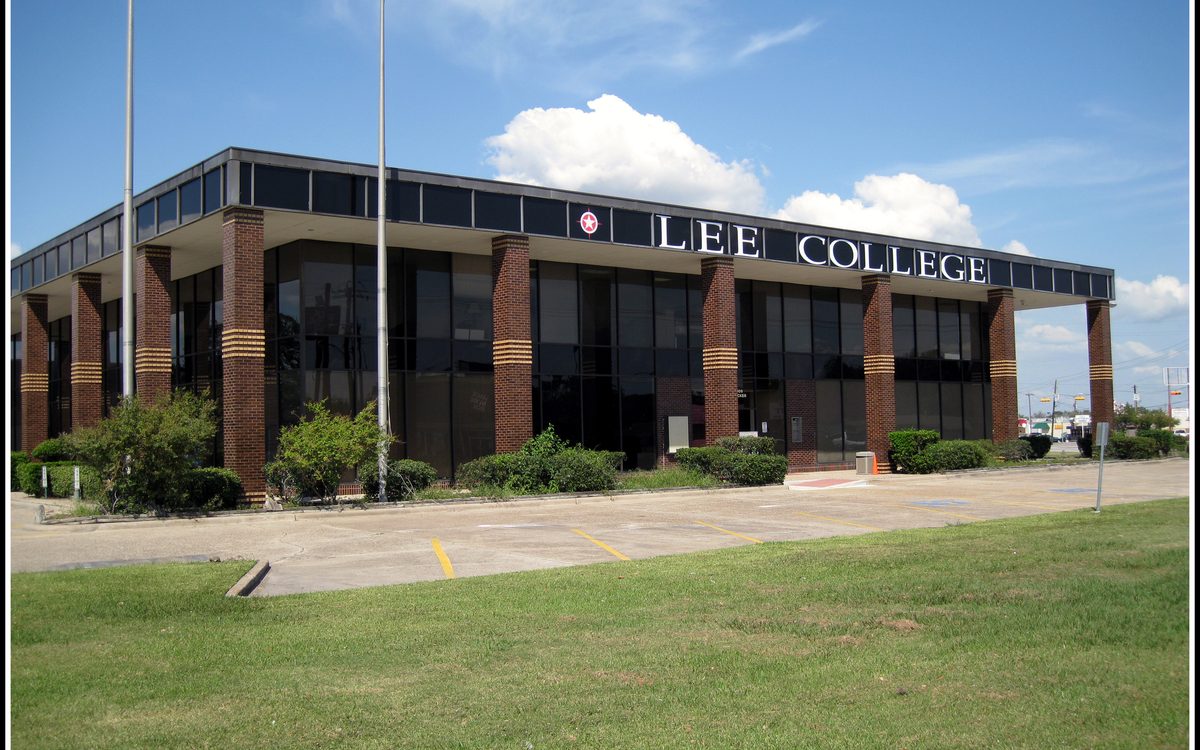
The program does not say where anybody is going. A good number of the people crossing that stage are not going to a four-year school in the fall, and are not going to the plants in the fall either, and are going to both, in order, over about two years. The community college in this town is Lee College. It was founded in 1934, a decade and a half after the refinery, which tells you what it was founded next to. It sits a few minutes from the fence, and it has for a long time been one of the places you go if you want to be on the other side of that fence with a badge instead of a visitor's pass. The programs that train operators, instrument techs, welders, and the rest run about two years, and they are the reason the town's version of "college" and the town's version of "the plant" are one path, walked in order.
This essay is about what that path looks like from inside it, as best it can be told without naming anyone or inventing a person.
The first thing to know is that it does not look like a path. It looks like a schedule. A kid graduates in May, works a summer, and by late August is sitting in a classroom learning what a pump curve is: the graph that says how much a pump can push against how much resistance, and where on that curve it will run itself to death. In programs like this there is a lab with a small training unit in it, real pipe and real valves and a tank with a sight glass, and the kid learns that the number on the screen and the level in the glass are the same thing, which is the whole job. There are classes in chemistry, where the kid learns that ethylene is a molecule with two carbons and a double bond, and that the plants down the road make it by heating heavier hydrocarbons to roughly 850 degrees Celsius until the bonds let go and rearrange, and that nothing in that furnace is destroyed, only sorted. There are classes in safety, which are not the boring ones. There is math, more of it than the kid expected.
The second thing to know is that it is a job before it is a job. The pathway is built on the idea that a person can learn the discipline of the work before they are inside the fence, so that the first day with a badge is not the first day they have ever stood in front of a running unit. By the time the two years are up the kid has heard the word "procedure" more often than any other word in the language and has come to understand that the procedure is not bureaucracy. It is the accumulated record of every time somebody got hurt, written down so that the next person does not. A step that says to open the bleed valve before the block valve is there because once, somewhere, somebody did it in the other order. In a plant, a procedure is a kind of memory. The town's whole safety culture is a kind of memory, and it is handed down in classrooms before it is handed down on the unit.
The third thing is the badge. There is no moment in the two years that matters as much as the first time the kid's own photograph is on a piece of plastic that opens a gate. Nobody frames it. It goes on a lanyard or a clip and gets scratched within a month. But the kid who has grown up in this town, who has watched the flare from the back seat of a car on Bayway Drive and heard the plant's name at every dinner table and had a parent or a neighbor or a coach walk out that gate at dusk for as long as they can remember, understands exactly what it is. It is the town saying: you are on the inside now. It is on you.
And there is the first day itself, which nobody puts on a program. Flame-resistant coveralls that are too stiff to be comfortable and will be too soft to be new in a year. Boots with steel in the toe. Hearing protection, because a running unit is loud in a way the classroom could not be. Heat, coming off the pipe and off the concrete and off the sky, all three. The kid stands at the base of a tower that was a drawing in a textbook nine months ago, and it hums, and it is taller than the drawing. Somebody who has been there twenty years says, without looking up, that the first year is mostly learning where things are. That is true. It is also the last easy thing anyone will say.
The plants on the channel are usually described, from outside, as machinery. Pipe, steel, furnaces, towers. A visitor sees the skyline from the bridge and sees a thing built. But a plant is not a thing. It is a process, and a process is people watching it. Every gauge on every unit is read by a person, or by an instrument that a person calibrated and a person will check. Every valve turns because somebody decided it should. The thousands of tons of ethylene the town sends out into the world every day do not come from steel. They come from a few thousand people who know what the steel is doing, and the kid crossing the stage in May, with the hard hat waiting in the truck, is the next one of those.
Aristotle's word for it was energeia, being-at-work. He did not mean a quantity in a tank; that idea was two thousand years off. He meant the state of a thing actively being what it is for, the way a builder building is more fully a builder than a builder asleep. The town has a strange and literal relationship to that word. It makes energy in the modern sense, in the tanks and drums and pipelines. But it makes it by means of energy in Aristotle's sense, by people being at their work. The two years at Lee College are less the transfer of a skill than the beginning of a person being at work, and the plant is where that work gets done.
There is a way to see the whole town in that, if you stand back. The oil in the tank is an old sea, the small dead things of it, held in the rock for an age. The procedure in the binder is old work, gathered by a century of people on units and held on paper. The kid on the stage is where the two get put together, where an old sea and old experience meet in one person who is awake and paying attention.
There is a larger way to say it, which the program will not use and the operator on the tower might, if you asked at the right hour. The kid is going to spend a working life sitting in front of a screen full of numbers that describe a furnace in which the remains of a sea, buried for hundreds of millions of years, are being taken apart and reassembled into molecules that will become the plastic in a hospital, the fuel in a rocket's first stage, the film over a field of vegetables. People say of astronomers that they are the universe getting a look at itself, matter that turned around and started asking what matter is. It fits the graduate with a hard hat as well, because what an operator does all night is precisely to know: to look at a piece of the universe doing something and understand what it is doing, well enough to keep it inside its limits. Nobody has to dress that up.
The pathway from the stage to the gate looks, from the outside, like a modest one. Two years. A certificate. A badge. Nobody writes about it. But it is the town's own way of turning a seventeen-year-old who has watched the flare into a person who understands the flare, and then into a person who is responsible for it, and there is nothing modest about that. It is how the town keeps running. It is how the town has kept running for a hundred years, since the refinery came to sit beside the Goose Creek field and the first people learned the first procedures on the first units, fifteen years before there was a college to learn them in.
Late May. The last of the ceremonies lets out into a parking lot that has been holding heat all afternoon. A kid in a gown that is already unzipped walks to a truck with the family trailing behind, tassel swinging, the cardboard mortarboard held in one hand because it will not stay on in this wind. On the passenger seat, where the kid throws it down, there is already a hard hat, white, unscratched, and the two of them sit there side by side while the family argues about where to eat.