The middle of April is when the country does its arithmetic. The forms are due. The envelopes go out, or the button gets clicked at eleven at night, and for a week or so everyone is a little sour about it, and then it passes, the way a norther passes, and by the end of the month nobody remembers what they were mad about. Tax Day is the one civic holiday with no parade. It is celebrated privately, at a kitchen table, with a calculator.
I want to use it for something better than complaining, because there's a piece of arithmetic in this town that almost nobody does out loud, and it's more interesting than the federal form.
Start with a bus. A yellow Goose Creek CISD bus, at seven in the morning, pulling up at a corner off Garth Road. The door folds open. A kid gets on with a backpack heavier than it should be. The bus has a driver who got up at five, a tank of diesel, a set of tires, an air conditioner that was rebuilt over the summer, a two-way radio, and a route that somebody in an office worked out on a computer. Every one of those things costs money. The kid didn't pay for any of it. Her parents paid for some of it. Who paid for the rest?
Now go up the road, fifteen minutes north on 146, to a classroom in Barbers Hill. A teacher at the front, a screen on the wall where a chalkboard used to be, twenty-two kids, a box of markers, a laptop cart. Same question. The teacher's salary, the screen, the roof, the air conditioning that runs from March to November, the markers. Who paid?
The answer, in Texas, is mostly the ground the building sits on and everything around it. That's what a tax base is. It is not a slogan or a number in a budget. It is the appraised value of every piece of property inside a district's lines, added up, with a rate applied. Texas has no state income tax, and the constitution forbids one; getting one would take an amendment and a vote of the people, and nobody is holding their breath. So the schools lean harder on property than in most states. The state sends money too, and a good deal of it, through a formula that fills in behind districts whose property is worth less. But the floor under a Texas school district is the land, the houses, the businesses, and whatever else of value stands inside its boundary.
The machinery of it is plainer than people think. Each county has an appraisal district, an office whose whole job is to put a number on every parcel once a year: the house, the strip center, the pasture, the plant. The numbers go on a roll. The roll is certified in the summer and handed to the school district, which looks at what it has to pay for and sets a rate, so many cents for every hundred dollars of value, one piece for running the schools and another for paying off the bonds that built them. Rate times roll is the levy. The bill comes in the fall. Nothing in it is mysterious; all of it is public; almost nobody reads it.
On this stretch of the coast, inside those boundaries, stands some of the most valuable industrial property in the country.
Under Mont Belvieu, in the Barbers Hill district, there is a salt dome, and inside the salt dome there are caverns, hollowed out with water over decades, and inside the caverns there are natural gas liquids by the many millions of barrels. It is the largest storage hub of its kind in the United States. Above the salt, three of the biggest midstream companies in the country run the towers that split those liquids into ethane and propane and butane, and the pipelines and pumps that move them. All of that is property. All of it is appraised. Somebody drives out to it, or more likely reads an engineer's report about it, and sets a number on it, and the district applies its rate.
Down here, inside the Goose Creek lines, is the refinery that Humble Oil began building in 1919 and had running by 1920, and that grew into one of the largest refining and petrochemical complexes in the country, plus the olefins plant, plus the chemical plant, plus the other companies' plants nearby. Also property. Also appraised. The tank farms along the channel, the docks, the furnaces, the cracker, the miles of pipe rack: every foot of it is on a roll somewhere with a value beside it.
So when the bus door folds open at seven in the morning, a real share of what's behind that door was paid for by a tank of propane in a cavern far under a field in Chambers County, or by a furnace on the channel that has been running since before the driver's grandfather was born. Not by the company as a gift. By the property, as a tax. The plant doesn't fund the school out of kindness. It funds the school because it is standing on the ground inside the district and the law says that what stands on the ground inside the district pays for the district. Kindness comes and goes. A tax roll is a tax roll.
I don't want to make this sound grander than it is. Everyone in Baytown knows, in a rough way, that the plants pay for things. It's in the air here like the smell off the channel on a south wind. But knowing it roughly is not the same as seeing the line run from the ground to the desk, and I think it's worth walking the line once, slowly, because it's the most honest description of a tax that I know.
A tax, at bottom, is the way a group of people who will never meet agree to pay for something none of them could pay for alone. Nobody in that classroom in Barbers Hill could buy the building. Nobody on that bus could pay the driver. The district can, because it collects a little from a great many and a great deal from a very few, and the very few in this case are companies that store hydrocarbons in salt and take them apart in furnaces. The kid in the third row does not know this. She will not know it for years. She'll know it the first time she looks at a paycheck stub and then, if she stays, the first time she gets a property tax bill and sees the district's name on it, and then, if she goes to work at a plant, the first time she understands what a unit is worth on the roll.
This is what people mean when they say a town like this one is built on the plants, and it's more literal than they usually intend. The gym floor, the marching band's uniforms, the science lab with the fume hoods that the district could afford because it sits where it sits: those are the plants, converted. Not converted into money and then given away. Converted by a tax rate into a public thing that belongs to nobody in particular and everybody in general, which is what a school is.
Now I have to say the complicated part, because the point of these essays is to be honest, and the honest version has edges.
A district with a very large industrial base is what the state calls property-wealthy, and property-wealthy districts in Texas do not keep everything they collect. The state takes a share and sends it to districts that have less. People here have opinions about that, strong ones, in both directions, and I'm not going to referee them. What I'll say is that the arrangement means that the salt under Mont Belvieu is putting money into a pot that helps pay for a bus somewhere out past Lubbock, too, in a district with cotton and not much else. Whether that's fair depends on where you're standing. You should at least know it when you're standing in the district that pays.
There is a second edge on the same blade. Not every dollar of plant sits on the roll at its full value all the time. When a company is deciding where to build the next unit, the state and the districts have for years had ways of promising it a lighter bill for a stretch of time, on the theory that some of a big number is better than all of nothing. Whether those deals are wise is another argument I won't referee. I'll only say that the line from the ground to the desk has a valve on it, and the valve is set by people, in meetings, with the minutes posted.
And the third edge. A tax base built on one industry is a tax base that rises and falls with that industry. Anyone who lived here through a bad year for oil knows what it looks like when the appraisals come in low, and anyone in a school office knows what it means to plan a budget around a number that a market in another hemisphere can move. Schools here have felt it, the way the hotels and the RV parks feel it when a turnaround crew doesn't come. Which is worth knowing, if only so you know what you're standing on.
There's one more line to walk, and it runs the other way.
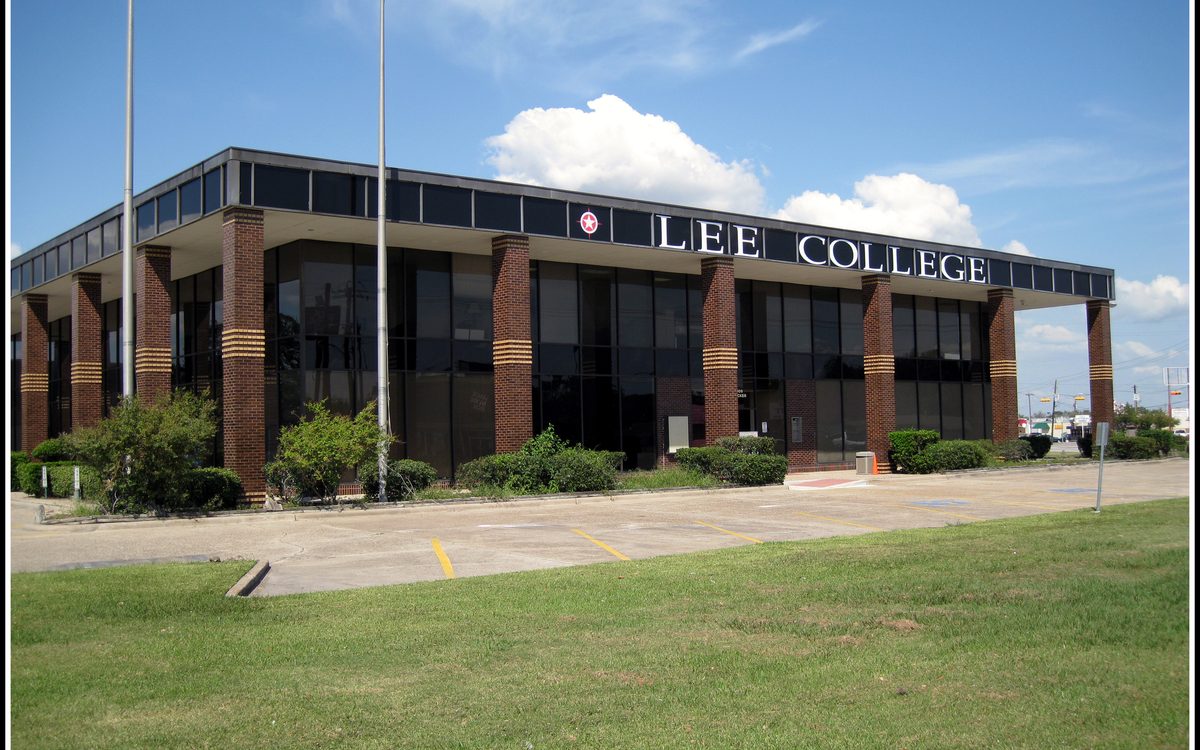
The kid on the bus grows up. Some of them leave, and that's fine; the town has always sent people out. But a lot of them go to Lee College for two years, which has a line of its own on the same tax bill, and then walk through a gate on the channel with a badge that still has the shine on it, and within a decade they are the operator on the tower, the instrument tech, the one who signs the permit. The plant paid for the school that made the worker who runs the plant. The loop closes. Not in a poetic way. In a payroll way. Property tax to district to classroom to Lee College to badge to paycheck to property tax. Around and around, one shift at a time, for a hundred years.
I've watched the flare from Bayland Park enough nights to have stopped seeing it as anything but what it is, which is a plant telling the truth about its pressure. But there is one way of looking at it that I've kept. Somewhere in that flame, if you traced the money instead of the molecules, is a fraction of a marker in a classroom in Barbers Hill and a fraction of a tire on a bus in Goose Creek. Not much of one. A cent of a cent. Multiplied by every furnace and every tank and every cavern in two counties, though, it comes to the buildings the kids walk into every morning.
Nobody sends a thank-you note to a tank farm. You couldn't, and it wouldn't read it. But it's April, and the forms are due, and everybody is doing their arithmetic, and it seems fair to do this one too, out loud, once.
The bus pulls away from the corner. The kid finds a seat by the window. Behind her, over the roofs, the top of a distillation column shows against the morning, and past it a line of tanks, and somewhere under the fields to the north a cavern full of what will become the plastic her lunch is wrapped in, all of it standing quietly on the roll, all of it paying, none of it aware.