There is a day in the third week of December when the sun gives up early and does not apologize for it. It is up a little after seven and down a little after five, and in between it never gets far off the ground. At noon on that day, from the pier at Bayland Park, it hangs over the bay to the south at about the height of a man's raised arm, thirty-some degrees up, throwing long shadows at midday like it is already evening. Then it slides down into the haze over the water and the flare takes over.
I go to the pier for it most years, not because anything happens but because nothing does. The solstice is a turning point you cannot see turn. The sun rises on that morning at very nearly the same spot on the skyline it rose the morning before, and it will rise the next morning at very nearly the same spot again. That is what the word means. Sol, sistere: the sun stands still. For a few days on either side, the place where it comes up stops drifting south along the skyline, holds, and then begins, so slowly you would need a surveyor to prove it, to walk back north.
The reason is a lean. The earth is tipped about twenty-three and a half degrees off square from the plane it circles the sun in, and it keeps that tip pointed at the same patch of sky all year long, like a spinning top that has settled. So for half the year the top half of the planet leans toward the sun and for half it leans away. On the shortest day the north is leaned as far away as it goes. The sun's light comes in low and glancing, spread thin over more ground, and the day is short because the sun's whole path across the sky is a low, short arc. You can put a number on it from the pier. At noon in June the sun stands better than eighty degrees up, nearly overhead, and a post throws almost no shadow. At noon on the shortest day it stands about thirty-seven, and the same post throws a shadow longer than the post. Distance has nothing to do with it. We are in fact closer to the sun in early January than at any other time of year, by about three million miles, and it does not help, because the lean matters more than the distance. Winter is the ground turning its face.
At this latitude the shortest day is still a little over ten hours long. That is generous. Go north and it shrinks: nine hours in Chicago, five and a half in Anchorage, and past the Arctic Circle it is gone entirely and the sun does not rise. Down here we lose about four hours of daylight between June and December and the loss is felt mostly as a change in the quality of the evening. In June you can fish off the pier at eight-thirty with the sky still lit. In December the sky is dark before the day shift has finished dinner. The bay looks different in that dark. Bigger, and closer.
There is a wrinkle here that the pier taught me before a book did. The evenings start getting longer before the solstice, and the mornings keep getting darker after it. At this latitude the earliest sunset of the year comes at the start of December, and the latest sunrise does not come until well into January, and the shortest day is the balance point between them, not the bottom of both. The cause is that the earth's path around the sun is not quite a circle and the earth is tilted on it, and the two together make the sun's noon slide against the clock by a few seconds a day this time of year, so that the whole daylight window drifts later even as it starts, barely, to widen. You can feel the two halves of it separately. The drive to work in the dark keeps getting darker into January. The drive home has been getting lighter since Thanksgiving. The mornings do not turn on the solstice; only the sum does.
When the sun is gone and the last of the color has drained out of the west, the flare on the channel becomes the brightest thing in the sky. It always is, on any night; but on the shortest night it has the longest run. Fourteen hours, near enough, between the last of one day and the first of the next, and for all fourteen it stands up out there over the plant with its top bent by the wind, orange, quiet from this far off, steady in a way that almost nothing else outdoors is steady.
A flare is the plant's safety valve, whatever it looks like from a pier. When a unit has more gas than it can use, or a unit trips, or something has to be emptied out fast, the gas goes to the stack and is burned in the open air rather than let loose. On an ordinary night what you see is a pilot and a small steady burn. When it gets big it means something is being handled. The people in the control room are watching the same flame you are, from the other side, as a number on a screen. What looks like a candle from the pier is a sentence. Most nights the sentence is: everything is fine, and here is the small amount of gas we could not find a better use for.
But there is another way to see it. People who lived by the sun noticed the day it stopped shrinking, and they marked it, with fire, almost everywhere they lived. They built a stone passage in Ireland that lets the sunrise in on this one morning and no other, and a ring of stones in England set on the solstice line, and they burned logs and hung lights in the dark, and when Christmas was fixed on the twenty-fifth of December, in Rome, by the fourth century, it landed in the same week, whatever the reasons, so that the fire kept going under a different name. The meaning of the fire was always the same and it has not changed. The dark is as deep as it is going to get. From here it turns.
The flare is that fire, whether anyone means it to be or not. It is about the biggest open flame you will see on this coast, and on the longest night it burns the longest, and it burns something older than any log. The gas at the top of the stack was alive once, in a shallow sea, under a sun nobody was watching, and it has been underground through ice ages and the rise and fall of everything with a spine, and a well brought it up, and the plant took what it could use, and the rest is going back to the sky tonight as light. I do not think anyone at the plant thinks of it this way, and they would be right not to; it is a relief valve, and the night it matters is the night it is big. But from the pier, on the shortest day, with every window in town lit and the heat running in every house to cover for the sun's short shift, the flare looks like what it is, which is a town keeping a fire against the dark, the way towns always have, only this one has a permit and a pilot and does not go out.
We all do this on the solstice night, at a smaller scale. Every lamp on in a kitchen, every porch string of lights, every headlight on 146 coming back from Galveston, every generator turning at every station on the grid, is the same argument with the same dark. The solstice is the day the ledger is most lopsided: the least sun in, the most fire out. The plant on the channel is the middle of that ledger. It takes crude and gas in one gate and sends out the other the things that make a house warm and lit, and it keeps a little for the flare, the visible remainder, the part that comes back out where you can see it.
The bay knows none of this, or knows it late. Water is slow. It holds heat the way the ground does not, and so the bay is still warm on the solstice, warmer than the air, and it will keep cooling into January and February after the days have already started to grow. The coldest water comes a month and more after the shortest day, the way the coldest hour of a night comes just before dawn. If the bay kept a calendar its solstice would be in February. Standing on the pier you can feel it: the air is cold and the water, when the wind brings the smell of it up, is not. The bay is running a little behind, holding the summer a while longer, spending it slowly, the way it does everything.
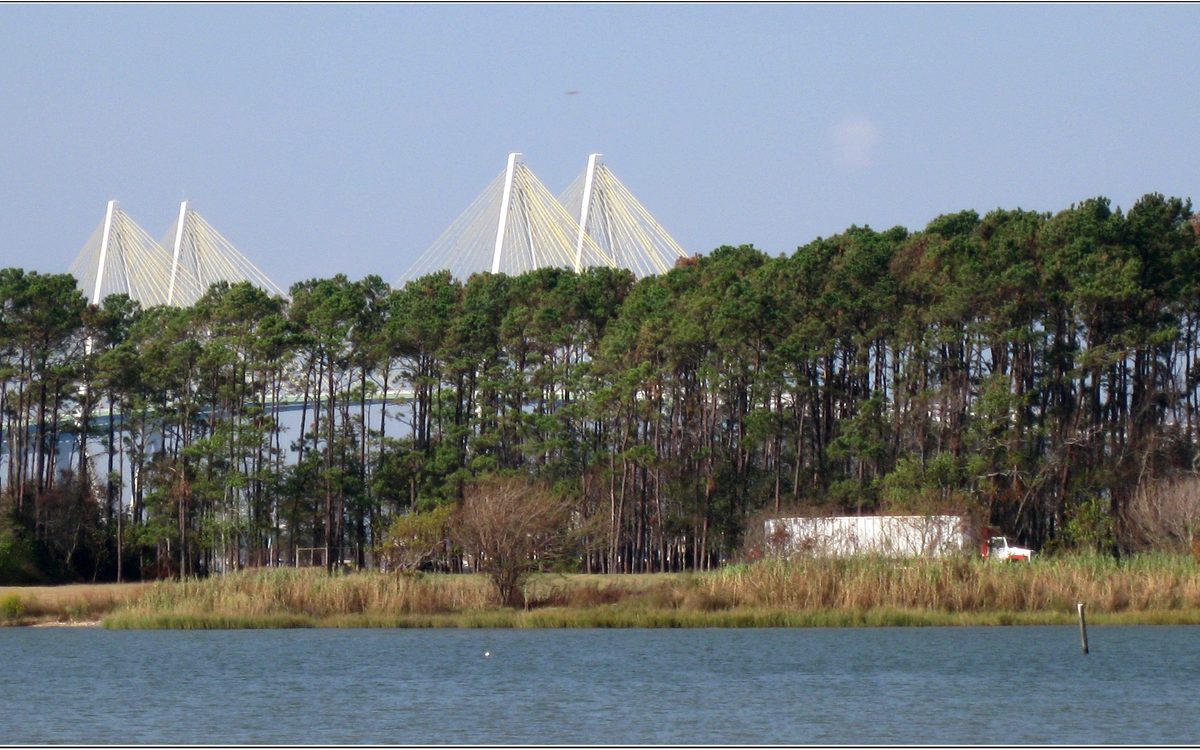
I stayed once until well after midnight, which is not necessary and I do not recommend it; the pier is not the warmest place in Harris County. But I wanted to see the turn. There is nothing to see, of course. The flare did what it did. The lights of the ships in the channel moved past at their walking pace. The bridge stood there to the south with its cables lit. Somewhere in the plant a shift changed and the same flame kept burning under different eyes. At some point, on a clock, the earth passed the place on its circle where the north pole leans furthest away, and began to lean back, and nothing on the bay moved differently at all.
The next morning the sun came up a hair later than the day before, in fact, the way it will for a few weeks yet, at a spot on the skyline you could not have told from the old one. But that evening it went down later still, and gave back more than the morning took, and the day was longer by a few seconds, and that was the whole event. The flare stood out there in the grey at dawn with its color washed out, fainter and fainter as the light came up behind it, and it did not go out. It only stopped being the brightest thing.